Why Growing Businesses Need the Right CRM Foundation
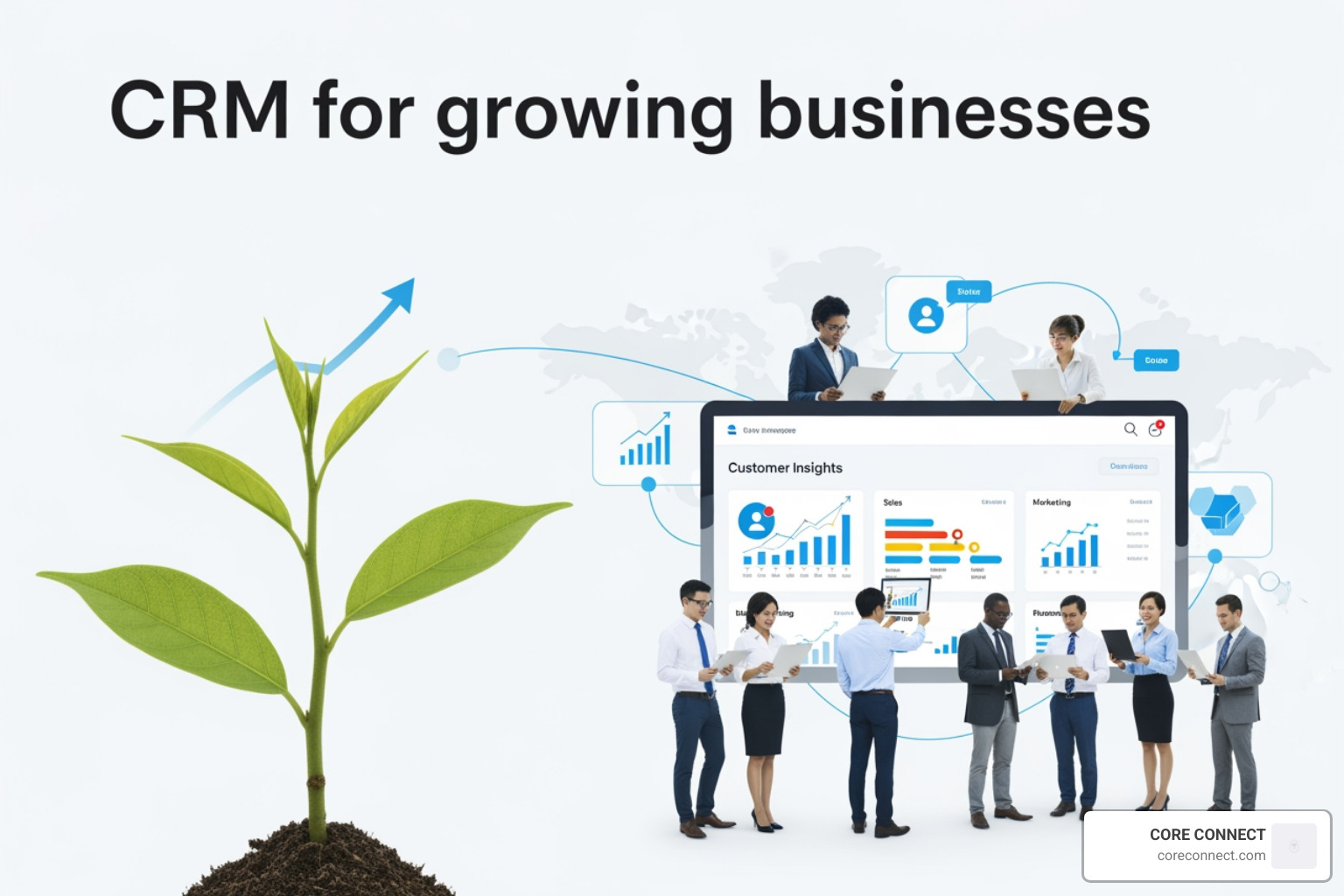
CRM for growing businesses is about more than just tracking contacts-it’s the foundation that determines whether your team can scale smoothly or struggle with chaos as you expand. Here’s what matters most:
Top CRM Priorities for Growing Businesses:
- Scalability – Handles more users, contacts, and data without performance issues
- Automation – Streamlines repetitive tasks so your team focuses on closing deals
- Integration – Connects with marketing, sales, and support tools you already use
- Mobile Access – Keeps your team productive from anywhere
- Clear ROI – Delivers measurable improvements in sales revenue and productivity
If you’ve ever tracked leads on sticky notes or lost track of who spoke to which contact last, you know the pain. That chaos multiplies as you grow. Without a solid CRM, you’re not just missing opportunities-you’re creating bottlenecks that slow down every part of your business.
The research backs this up: 63% of small and mid-size business leaders say a CRM helps them provide better or faster customer service. 64% rate automation capabilities as extremely important. And with 99% of IT leaders saying businesses must be mobile-enabled to survive, choosing the right CRM isn’t optional anymore.
If you want a quick, neutral definition of what a CRM is and why companies use one, see Customer relationship management.
But here’s the problem: most growing businesses either choose a CRM that’s too basic and outgrow it quickly, or they pick an enterprise system that’s too complex and expensive for their current needs. Finding that sweet spot-a system that grows with you rather than against you-is what separates companies that scale smoothly from those that plateau.
The right CRM doesn’t just store contact information. It becomes your single source of truth for customer data, automates your sales processes, and frees up your team to focus on strategic work instead of administrative tasks. It helps you enter new markets, reduce operational costs, and turn anonymous website visitors into qualified leads.
I’m Stephen Sovenyhazy, founder of CORE CONNECT, and I’ve spent over 20 years helping businesses build digital systems they actually own and control. I’ve seen how the right CRM for growing businesses transforms operations-and how the wrong one creates expensive headaches that compound over time.
Essential Features of a CRM for Growing Businesses
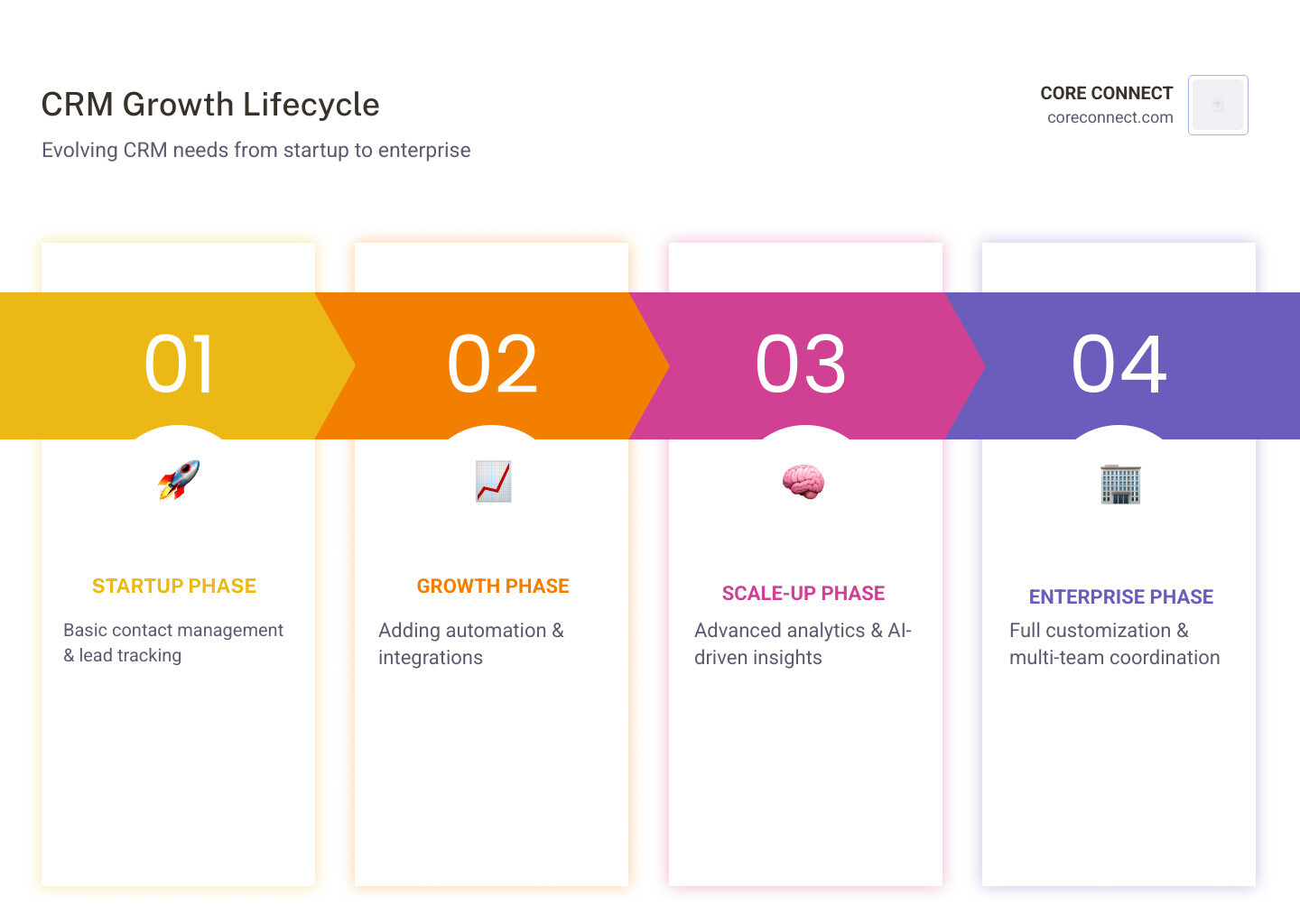
When we talk about a CRM for growing businesses, we aren’t just looking for a digital Rolodex. We need a system that acts as the “nervous system” of our company. As we expand here in the Lowcountry, our needs shift from simply “knowing who the customer is” to “knowing exactly what the customer needs next.”
Contact Management and Lead Tracking
At the most basic level, your CRM must excel at contact management. This means more than just storing an email address. It’s about having a 360-degree view of every interaction. If a prospect talks to a sales rep in Mount Pleasant and then calls support two days later, that support agent should see the notes from the sales call instantly. No more “Sorry, who did you speak with again?” moments.
Pipeline Visibility
We need to see where our money is. A visual sales pipeline dashboard allows us to track leads through every stage of the sales cycle. For a growing business, this visibility is the difference between guessing your end-of-month revenue and knowing it.
Workflow Automation
This is the “secret sauce” for scaling. Research shows that 64% of SMB leaders prioritize automation. Why? Because manual data entry is a growth killer. A scalable CRM should automate:
- Changing lead status based on actions (like downloading a guide).
- Sending follow-up emails after a meeting.
- Scoring leads so your sales team focuses on the “hottest” opportunities first.
Choosing the Right Features
To help you steer the sea of options, we’ve put together a quick guide to help you distinguish between what you need now and what you’ll need as you scale.
| Feature | Essential (Startup) | Advanced (Scale-Up) |
|---|---|---|
| Data Storage | Basic contact info | Full interaction history & document management |
| Automation | Simple email alerts | Multi-stage workflows & AI-driven triggers |
| Reporting | Basic sales totals | Predictive forecasting & custom dashboards |
| Integrations | Email & Calendar | Accounting, Marketing Hubs, & VoIP |
| AI | None/Basic | Lead scoring & sentiment analysis |
How Scalability Drives Long-Term Business Expansion
Scalability isn’t just a buzzword; it’s the ability of your software to handle more “stuff”—more data, more users, and more complex processes—without falling apart. If your CRM slows down the moment you hit 1,000 contacts, it’s not a CRM for growing businesses; it’s a hurdle.
Managing Data in a CRM for Growing Businesses
As you grow, the volume and velocity of your data increase. A scalable system uses a centralized, cloud-based database. This ensures that whether your team is in a Charleston office or working remotely from home, everyone has a “single source of truth.”
Key data characteristics to look for:
- Activity Tracking: Every email, call, and meeting is logged automatically.
- Customer History: A timeline of every touchpoint the customer has had with your brand.
- Data Security: Robust encryption and multifactor authentication to protect your most valuable asset—your client list.
Evaluating the ROI of a CRM for Growing Businesses
Investing in a robust system early on might feel like a big step, but the long-term advantages are massive. Small businesses using advanced CRM suites have reported:
- 41% increase in sales revenue.
- 36% increase in employee productivity.
- 38% increase in marketing-led growth.
By automating administrative tasks, your team can spend more time on marketing strategies guaranteed to grow your business and less time on spreadsheets.
The Role of AI and Automation in Modern CRM Systems
Welcome to the future. AI is no longer just for big tech companies; it’s now a core component of any competitive CRM for growing businesses.
Lead Scoring and Predictive Analytics
Imagine if your CRM could tell you which lead is 80% likely to close based on their behavior. Modern CRM systems use AI assistants to analyze website visits and email engagement. This allows your team to prioritize high-value targets rather than chasing every lead that comes through the door.
Chatbots and Task Automation
AI-powered chatbots can handle lead qualification 24/7. They answer common questions, schedule meetings, and even route complex issues to the right human agent. This ensures that no prospect is left waiting, even if they reach out at 2:00 AM on a Sunday. For more on how to use these tools, check out our insights on smarter business with AI.
Integrating Your CRM with Other Growth Tools
A CRM shouldn’t live on an island. To truly fuel growth, it needs to talk to your other tools. This is where many businesses in the Lowcountry find their competitive edge.
Marketing Automation and Real-Time Visitor Intelligence
At CORE CONNECT, we believe the most powerful growth happens when your CRM is integrated with your website. Our proprietary platform, Reveal Marketing Hub, unifies your CRM with real-time visitor intelligence.
Most CRMs tell you what your known customers are doing. Our technology goes a step further by identifying who is visiting your website—even if they haven’t filled out a form yet. We call this website visitor identification. When you know exactly which companies are browsing your services, your sales team can reach out with surgical precision.
Essential Integrations for Growth:
- Email & SMS: Connect your CRM to your communication tools for instant email marketing and SMS follow-ups.
- Accounting: CRM systems that integrate with tools like QuickBooks ensure your sales and finance teams are always in sync.
- Social Media: Monitor brand mentions and engage with leads directly through integrated CRM platforms.
Top CRM Platforms Recommended for Growing Businesses
Choosing the right platform is a big decision. Here is a roundup of the types of systems we often recommend for different growth stages:
- Unified Growth Platforms: Perfect for those who want to start with a solid foundation and scale. These offer a full suite of tools that grow as you do, combining CRM with marketing automation.
- Enterprise Solutions: The industry standard for aggressive scaling. These offer extensive integration ecosystems, making them incredibly customizable for complex organizations.
- Value-Driven Scalable CRMs: Known for cost-effective scalability. These are a great “middle ground” for businesses that want power without the enterprise price tag.
- Sales-Focused Pipelines: If your primary focus is sales, look for a clean, visual interface that sales teams actually enjoy using to track deals.
- Flexible Workflow Managers: Highly flexible and great for teams that need to customize their workflows beyond traditional sales pipelines to include project management.
Frequently Asked Questions on Scaling Your CRM
What are the key differences between small business and enterprise CRMs?
Small business CRMs focus on ease of use and core features like contact management. Enterprise CRMs, or “Scale-Up” CRMs, offer deeper customization, advanced AI, multi-departmental workflows, and the ability to handle massive datasets without lag.
How does CRM pricing change as a business scales?
Most CRMs use a per-user, per-month pricing model. As you grow, you’ll likely move from “Starter” tiers ($25-$50/user) to “Professional” or “Enterprise” tiers ($75-$150+/user). Some platforms also charge based on the number of contacts in your database. It’s vital to factor these jumps into your long-term budget.
Why is mobile access important for a growing sales team?
99% of IT leaders agree: mobile-enablement is vital. A mobile CRM allows your team to update deal statuses, check client history, and respond to leads while they’re out in the field—whether that’s at a meeting in downtown Charleston or a site visit in Mount Pleasant.
Conclusion
Finding the perfect CRM for growing businesses is about balancing where you are today with where you want to be tomorrow. It’s about building a system that provides clarity, automates the mundane, and gives you the data you need to make smart decisions.
At CORE CONNECT, we specialize in providing the systems behind the growth. Through our Reveal Marketing Hub, we offer a unified growth platform that combines CRM, automation, and advanced website design to help you scale with total control.
Whether you want us to manage it all for you or you want to use our professional-grade tools to run your own marketing in-house, we’re here to help you turn anonymous traffic into real revenue.
Ready to see who’s actually on your website and start fueling your growth? Request a Quote today, or learn more about how we help Lowcountry businesses thrive.