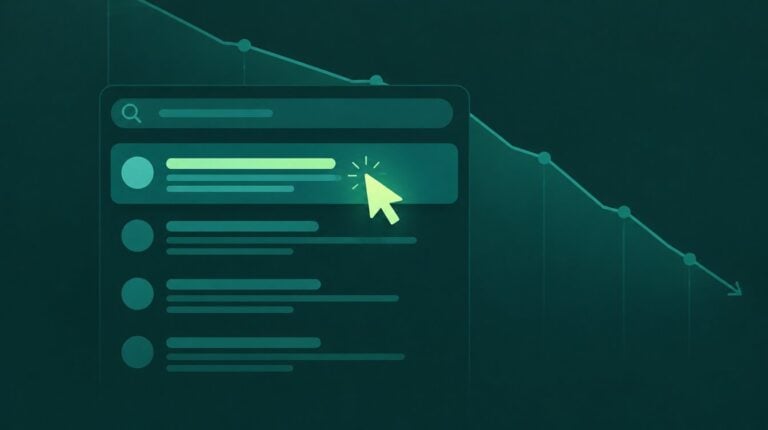

Earlier this year, Walmart ran one of the biggest real-world tests of AI shopping anyone has published. It put about 200,000 products inside ChatGPT so people could buy without ever leaving the chat. The result surprised a lot of people: purchases made inside ChatGPT converted at roughly one-third the rate of shoppers who clicked through to Walmart’s own website (Search Engine Land).
Walmart didn’t walk away from AI. It launched its own Sparky shopping assistant inside ChatGPT instead, so discovery happens in the chat and checkout happens on Walmart’s terms (eMarketer). It walked away from letting someone else run the checkout.
If you own a law firm, an HVAC company, a med spa or a marina in Charleston or Mount Pleasant, that story answers a question we hear almost every week: if ChatGPT and Google’s AI answer everything now, does my business still need a website?
Short answer: yes. But the website’s job has changed, and most small-business sites aren’t built for the new job yet.
The customer path now has a gatekeeper in front of it
For twenty years the path was simple. Someone searched, clicked, landed on your site and called. Your website was built for one visitor: a person who just clicked.
Now there’s a step before that person ever sees you. An AI assistant reads what it can find about every business in your category, then decides who makes the shortlist. Only after that does a human go check whether the recommendation holds up.
So you’re really convincing two audiences:
- The machine needs clear, consistent facts: what you do, who it’s for, where you work, what it costs, when you’re open.
- The person needs proof: reviews, real results, real photos, a site that feels like a real business.
And the person really does check. In a July 2026 Semrush survey of more than 600 U.S. business buyers, 71% said they visit a vendor’s website after an AI tool mentions it, and 63% go search for the company on Google (Semrush). NP Digital surveyed 2,084 people who search with AI and found that when an assistant named just one company, 49% of them did nothing at all. When it named three, 61% kept researching (NP Digital).
An AI mention rarely closes a deal on its own. It starts an investigation, and your website is where that investigation ends, one way or the other.
Why your analytics make AI look smaller than it is
Open Google Analytics and AI probably barely registers. That’s normal. Wix’s 2026 State of Websites report found that LLMs still send less than 1% of site traffic across its user base (Wix). Plenty of owners see that number and decide AI is a 2028 problem.
Two things make that a mistake.
First, the traffic AI does send is unusually valuable. Adobe tracks visits to U.S. retail sites. In March 2025, shoppers arriving from AI tools converted 38% worse than everyone else. By March 2026, they converted 42% better, a record (Adobe). Those visitors show up further along in their decision, because the AI already did the comparison shopping.
Second, a lot of AI’s influence never shows up as an AI referral. Someone asks ChatGPT for a roofer in West Ashley, hears your name, and two days later types your business name into Google. Analytics credits Google, or “direct.” The AI did the selling and gets none of the credit. (We wrote about how to measure AI visibility when calls are the scoreboard if you want the full picture.)
Small channel, high intent, and much of its impact is hiding inside your other numbers.
Why “checkout inside the AI” hasn’t replaced your site
The big platforms want the whole transaction. OpenAI launched Instant Checkout in ChatGPT in late 2025. Google has since rolled out a buy button inside AI Mode and the Gemini app for eligible U.S. merchants, built on its new Universal Commerce Protocol (Search Engine Roundtable).
That will keep improving. But Walmart’s own executive in charge of product called the in-chat experience unsatisfying (MarTech), and it’s easy to see why. Walmart’s own site already has the cart, the saved account, the order history, the loyalty perks and the support. A chat window has none of that context.
For a local service business the “checkout” isn’t a cart. It’s the phone call, the booking form, the consultation request. That step still happens on an experience you control: your website, your Google Business Profile, your phone line. Hand it to a platform you don’t control and you give up the moment people actually decide.
Can you get by with just a Google Business Profile?
n
Sometimes, for a while. A brand-new or word-of-mouth business can start with a phone number, a Google Business Profile and a handful of reviews. But a profile is rented space: Google decides the layout, you get a short description, and there is no room for a real page on each service, your service areas, how pricing works or a detailed customer result. Those are exactly the details AI assistants look for when they decide who fits a specific question. A profile gets you on the map. A website gives the machine, and the person checking up on you, enough to choose you.
n
Machines need clarity. People need proof.
Here’s the good news for smaller businesses. You don’t have to be the biggest name in Charleston to get recommended.
In the same Semrush survey, only 7% of buyers said they noticed a vendor in an AI answer because they recognized the name. The top reason, at 53%, was that the vendor closely matched their specific situation (PPC Land summary of Semrush data). The clearest match beats the most famous name.
That means two jobs for your website and everything around it. They line up with the first two parts of our CORE Method: get Found, then get Trusted.
1. Be easy for machines to understand. Every core service gets its own page that says who it’s for, where you do it and how pricing works. Your hours, service areas and offerings match everywhere AI pulls from: your website, your Google Business Profile, Yelp, Angi, your Facebook page and industry directories. If your site lists three cities, your Google profile lists two and an old directory still shows a service you dropped last year, the AI has to guess. When it guesses wrong, you pay for it. This is the heart of what we do at CORE CONNECT: run your website, Google profile and listings as one connected system, so every source tells the same story and you get found everywhere customers search.
2. Be easy for people to believe. Proof closes. Wix found that sites with 50 or more reviews earned about 40 times more median revenue than sites with fewer (Wix). That’s a correlation, not proof that reviews cause growth, but it lines up with what we see every month: the businesses that win the verification visit show real reviews, named results and real photos. (Here’s our guide on getting more Google reviews without breaking Google’s rules.)
The 2-minute test you can run tonight
Open ChatGPT or Gemini and type the exact question your best customer would ask. Make it specific and local:
- “Who’s the best HVAC company in Mount Pleasant for an older home?”
- “Which Charleston law firm handles boating accident cases?”
- “Where can I get Pilates instructor training near Charleston?”
Then check two things:
- Are you on the list?
- If you are, is what it says about you correct? Hours, services, service area, price range, specialties.
This isn’t a scientific audit. Answers change by platform, by wording and by day. But it’s a fast snapshot of how one AI currently describes your business.
Then fix the first gap you find:
- Not listed? Make sure the service it was asked about has its own page on your site, and that your Google Business Profile names that service and that town.
- Listed but wrong? Find where the bad fact lives (an old directory listing, an outdated page, a stale Google profile field) and correct it everywhere, not just on your site.
- Listed and right? Strengthen the proof on that service page: one named customer result, recent reviews and a clear next step.
Frequently asked questions
Does my business still need a website if customers find me through AI?
Yes. AI assistants build their answers from what they can read about you, and your website is the source you fully control. After an AI recommendation, most people go check the business’s website or search for it on Google before they call.
Can I just use a Google Business Profile instead of a website?
n
You can start there, especially if you are new or work mostly by referral. But a profile has no room for a page on each service, your service areas or detailed proof, and those are the details AI assistants and careful buyers look for. Most growing service businesses need both, saying the same thing.
n
Why doesn’t AI traffic show up much in Google Analytics?
AI tools send a small share of direct clicks, and many people who hear about you in an AI answer later search your name or type your web address. Analytics credits those visits to Google or “direct,” so AI’s real influence is undercounted.
What’s the fastest way to improve how AI describes my business?
Ask an AI assistant the question your best customer would ask, check whether the answer about you is accurate, and correct the first mismatch you find across your website, Google Business Profile and directory listings.
Want us to run the full check?
The 2-minute test shows you one answer from one AI. Our free audit looks at how ChatGPT, Gemini and Google describe your business, finds every place your information doesn’t match, and gives you a prioritized fix list. Request your free website review, or see how our web design and local SEO work fit together.
Your website still matters in 2027. Its job just got bigger: your information has to earn the shortlist, and your website has to earn the trust.