
The Real-Time Lead Identification Guide for Digital Detectives
Why Real-Time Lead Identification Changes Everything
Real-time lead identification is the process of instantly recognizing and capturing buying signals the moment they happen—whether that’s a prospect visiting your pricing page, downloading a case study, or researching your solution category. Unlike traditional lead scoring that updates overnight or weekly, real-time systems detect intent as it occurs and trigger immediate action.
Quick Answer: What is Real-Time Lead Identification?
- Live Signal Capture: Monitors website visits, content downloads, email opens, and third-party intent data in real time
- Instant Scoring: Updates lead scores continuously based on behavioral, firmographic, and technographic signals
- Immediate Activation: Triggers alerts, CRM updates, and automated workflows within seconds
- Speed-to-Lead Advantage: Enables sales teams to engage prospects while interest is hot—not hours or days later
The problem most businesses face isn’t a lack of traffic. It’s that by the time they realize someone is interested, that prospect has already taken calls from two competitors. The average B2B company takes 42 hours to respond to an inbound lead, and more than 30% of leads are never contacted at all. Meanwhile, responding within 5 minutes makes you 21 times more likely to qualify a lead compared to waiting just 30 minutes.
This gap between when interest happens and when you act is where deals are won or lost. Real-time lead identification closes that gap by turning anonymous website visitors into identified prospects with contact details, firmographic data, and behavioral context—instantly.
I’m Stephen Sovenyhazy, founder of CORE CONNECT, and I’ve spent over 20 years building digital platforms that turn websites into revenue engines. Our proprietary visitor identification system has helped businesses convert anonymous traffic into qualified pipeline by implementing real-time lead identification workflows that integrate directly with CRM and marketing automation platforms.
The Mechanics of Real-Time Lead Identification
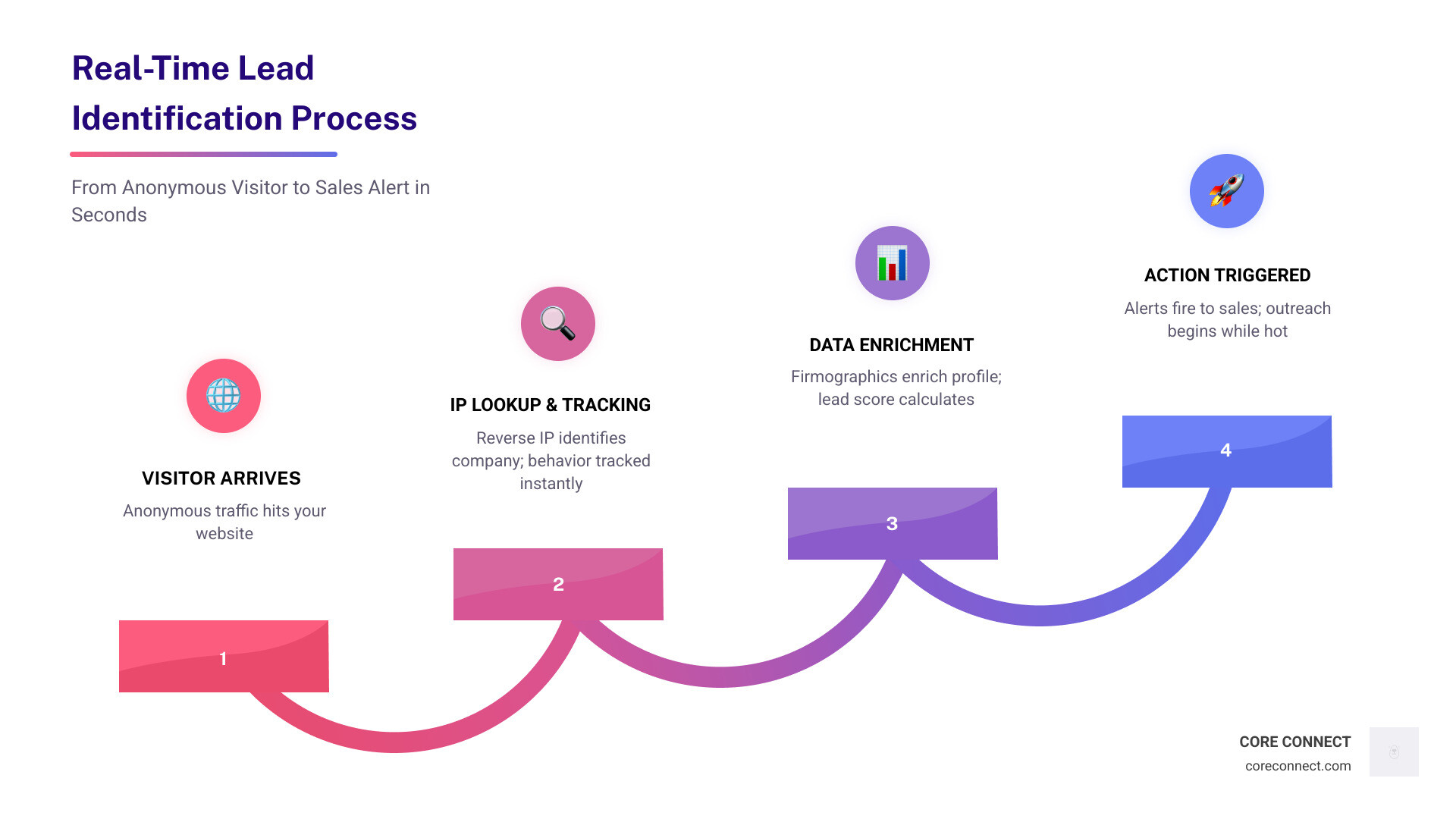
At its core, real-time lead identification functions like a high-tech digital dragnet. It doesn’t wait for a user to fill out a form to begin the qualification process. Instead, it uses a sophisticated blend of technologies to deanonymize traffic as it hits your server.

The process begins with event streaming. Every click, scroll, and page view is treated as a discrete data point that flows into a processing engine. Unlike legacy systems that process data in “batches” (usually at night when everyone is asleep), real-time systems use continuous calculation. If a prospect visits your pricing page three times in ten minutes, their score increases three times in ten minutes—not the next morning.
The technical heavy lifting is often handled by reverse IP lookup. By cross-referencing a visitor’s IP address against massive databases of B2B registrations, these tools can identify the specific company visiting your site. Research shows that IP-to-company databases are incredibly dynamic, with roughly 20% of the data changing every month. This is why we prioritize daily database refreshes to ensure accuracy.
Once the company is identified, the system performs firmographic enrichment. It pulls in data points like industry, annual revenue, employee count, and headquarters location. This allows you to Turn Buyer Signals Into Real-Time GTM Intelligence by instantly knowing if the visitor fits your Ideal Customer Profile (ICP).
| Feature | Traditional Lead Scoring | Real-Time Lead Identification |
|---|---|---|
| Data Processing | Batch (Daily/Weekly) | Continuous (Instant) |
| Primary Input | Form Fills/Email Clicks | Web Behavior/Intent Signals |
| Identification | Known Contacts Only | Anonymous & Known Accounts |
| Response Time | 24–48 Hours | Seconds to Minutes |
| Context | Static/Historical | Dynamic/Current |
Real-Time Lead Identification vs. Traditional Scoring
Traditional lead scoring is like looking at a photograph of a race; you see where everyone was at a single moment in time. Real-time lead identification is like watching the live video feed.
The biggest enemy of traditional scoring is data decay. By the time a “hot lead” report lands on a sales rep’s desk on Tuesday morning, the prospect who was browsing on Friday afternoon has likely moved on. Real-time systems prioritize recency weighting. An action taken sixty seconds ago is infinitely more valuable than an action taken sixty days ago. This dynamic context allows sales teams to recognize “sales readiness” the moment a prospect crosses a pre-defined threshold.
Leveraging AI for Real-Time Lead Identification
Artificial Intelligence has turned the “needle in a haystack” problem of lead generation into a manageable science. By using Machine Learning (ML) and Natural Language Processing (NLP), modern systems can filter through millions of noisy market leads to find “compelling events.”
These compelling events might be external triggers—like a target company announcing a new funding round, a merger, or a massive hiring spree—combined with internal signals like a sudden surge in website activity from that same company. AI helps by:
- Predicting Lead Value: Analyzing historical conversion data to see which combinations of signals actually result in closed deals.
- Signal-to-Noise Filtering: Automatically removing bot traffic, ISPs, and low-quality visitors so your sales team only focuses on legitimate opportunities.
- Buying Group Detection: Identifying when multiple people from the same organization are researching your solution simultaneously, which is a massive indicator of a nearing purchase decision.
Why Speed-to-Lead Dictates B2B Success
In B2B sales, the “early bird” doesn’t just get the worm; they get the entire contract. The speed-to-lead metric is perhaps the single most important KPI for modern revenue teams.
The statistics are staggering:
- The 5-Minute Rule: You are 21 times more likely to qualify a lead if you respond within five minutes versus thirty minutes, according to research published in the Harvard Business Review.
- First-Responder Advantage: 78% of buyers go with the first company that responds to them. Furthermore, the first vendor to respond wins 35-50% of the sales.
- The Reality Gap: Despite these facts, the average B2B company takes 42 hours to respond.
When you implement real-time lead identification, you aren’t just getting better data; you are buying time. By identifying a high-intent visitor while they are still on your website, your sales team can reach out while the prospect’s pain points are top-of-mind. This drastically improves pipeline quality because you are engaging prospects during their active evaluation phase, not trying to re-spark their interest days later.
Identifying High-Intent Buying Signals
Not all website traffic is created equal. A student researching a blog post for a class project is a very different “lead” than a VP of Operations looking at your “Enterprise Integration” page.
To succeed, you must monitor a variety of buying intent signals:
- Behavioral Signals: These are the “digital body language” cues. Repeated visits to a pricing page, downloading a technical whitepaper, or spending ten minutes on a case study page are high-intent actions.
- Technographic Data: Knowing what tools your prospect already uses can be a major signal. If they just installed a competitor’s software or a complementary tool, it’s time to move.
- Social Signals: Are they mentioning your brand on LinkedIn? Are they engaging with your executive team’s posts?
- Engagement Triggers: High email open rates or clicks on specific “bottom-of-the-funnel” links.
The key is ICP Alignment. A “surge” in activity is only valuable if it comes from a company that actually fits your target demographics (industry, size, and location).
Best Practices for Implementation
Setting up a system is only half the battle; you have to manage it correctly to avoid burning out your sales team.
- Threshold-Based Automation: Don’t alert your team for every single click. Set intelligent thresholds. For example, a Slack notification only triggers when a lead reaches a score of 70, and an auto-assignment to a senior rep happens at a score of 80.
- Combat Alert Fatigue: If sales reps receive 50 “hot lead” alerts a day that turn out to be duds, they will stop checking them. Use AI to ensure the “signal-to-noise” ratio remains high.
- Personalized Outreach: Never use a generic “I saw you on our website” message. Instead, use the data to be helpful: “I saw you were looking at our guide on reducing churn; I thought this case study on how we helped a similar firm might be useful.”
- Feedback Loops: Marketing and sales must meet regularly to discuss lead quality. If the “high-intent” leads aren’t converting, the scoring model needs to be adjusted.
- Data Hygiene: Regularly clean your CRM and ensure your reverse IP lookup provider is updating their database daily.
Frequently Asked Questions about Real-Time Leads
What are the most common mistakes to avoid in real-time identification?
The most frequent pitfall is overreacting to weak signals. One person from a large company visiting a single blog post isn’t necessarily a “buying signal”—it might just be a casual reader. You must wait for patterns or “surges” before sounding the alarm.
Another mistake is ignoring fit for behavior. A tiny startup might spend hours on your site, but if they can’t afford your services, they aren’t a qualified lead. Always combine behavioral scores with firmographic “fit” scores. Finally, many organizations fail because they have a lack of strategy. They buy the tools but don’t define the sales playbooks for what happens when a signal appears.
How does real-time identification impact sales conversion rates?
By enabling immediate engagement, you catch the prospect at the peak of their interest. This leads to significantly higher response rates because you are a relevant solution to a problem they are currently thinking about. Consequently, this leads to shorter sales cycles—you skip the “re-introduction” phase and move straight to solving problems. This creates a much higher ROI on your marketing spend, as fewer leads evaporate into the “42-hour response” black hole.
Do I need a large team to manage these signals?
Absolutely not. In fact, real-time lead identification is designed to make small teams act like large ones. Through automation and CRM integration, the system does the heavy lifting of watching the traffic, scoring the leads, and routing them to the right person.
At CORE CONNECT, we offer managed services where we handle the technical setup and optimization of these systems for you. Whether you use our Reveal Marketing Hub to run it yourself or have us manage the growth engine for you, the goal is scalable workflows that don’t require you to hire a dozen data analysts.
Conclusion
In the competitive landscape of Charleston and the Lowcountry, waiting for leads to find you is no longer enough. You need to be a digital detective, identifying intent the second it manifests. Real-time lead identification isn’t just a “nice-to-have” feature; it is the backbone of a modern revenue engine.
At CORE CONNECT, we specialize in providing the clarity and control businesses need to scale. Our Reveal Marketing Hub is a proprietary growth platform that unifies your CRM, email, and SMS automation with advanced visitor intelligence. We don’t just show you that people are visiting your site; we expose who they are, where they came from, and what they want.
By combining conversion-focused website design with real-time data, we help you make smarter decisions and act faster on opportunities. Don’t let your next big contract slip through the cracks because of a 42-hour delay. It’s time to Identify website visitors instantly and turn your anonymous traffic into real revenue. Reach out to us in Charleston or Mount Pleasant today, and let’s build your growth system together.