
Fix Your Leaky Sales Pipeline for Good
Why a Leaky Sales Pipeline Is Silently Killing Your Revenue
Improving your sales pipeline is one of the highest-leverage moves any service business can make — and most owners don’t realize how much revenue is quietly slipping away until it’s too late.
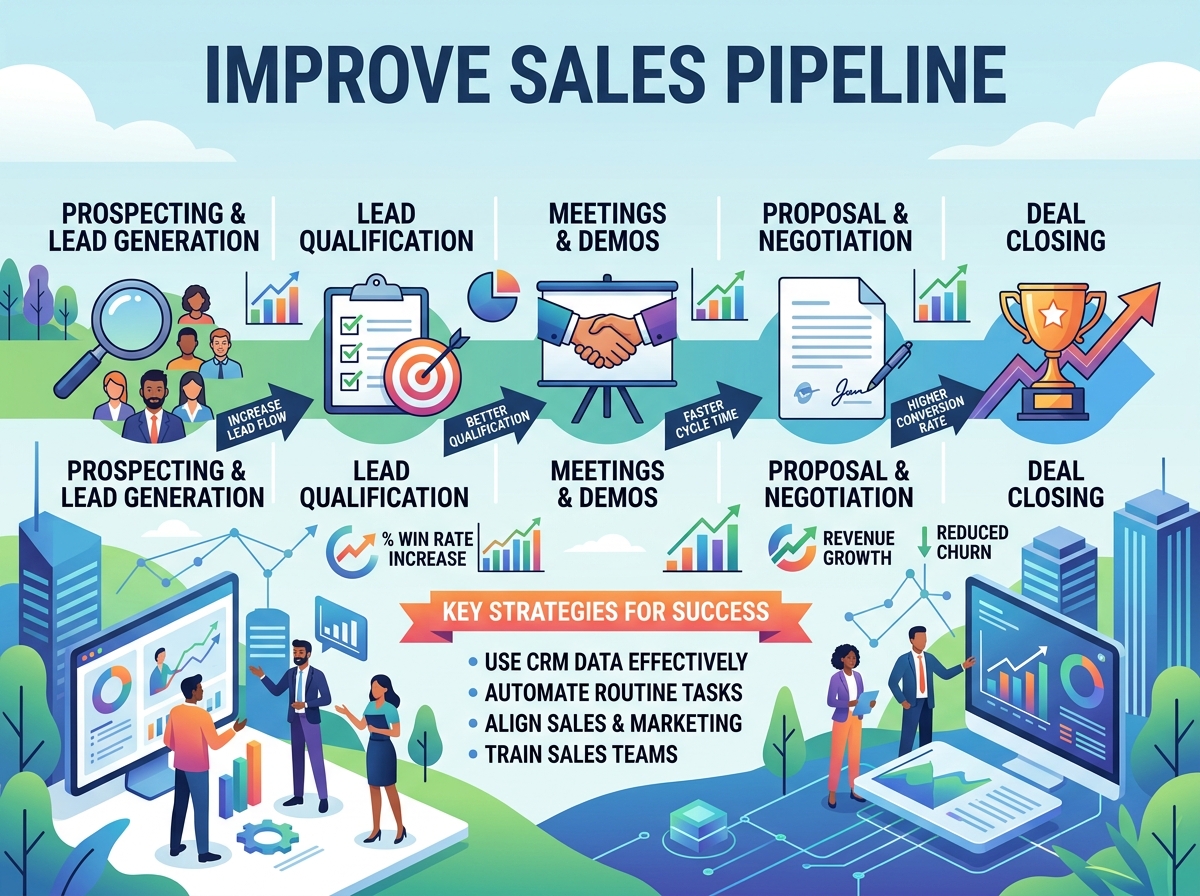
Here’s a quick snapshot of what it takes to fix a leaky pipeline:
- Define clear stages — every deal needs a defined home in your process
- Qualify leads early — stop chasing prospects who were never a fit
- Follow up consistently — 80% of leads need 5–12 touches before deciding
- Track the right metrics — velocity, win rate, and pipeline coverage ratio
- Automate where possible — CRM automation keeps deals moving without manual effort
- Align sales and marketing — both teams must agree on what a “good lead” looks like
- Review regularly — weekly reviews catch stalled deals before they go cold
Think about the last time a promising lead just… disappeared. No response. No closure. Just gone. That’s not bad luck — that’s a pipeline problem.
The numbers paint a sobering picture. Only 5% of the key information from customer calls ever makes it into a CRM. Sales cycles are now running 21% longer than they were in 2020. And companies with a well-defined sales process generate 18% more revenue than those without one.
For business owners in Charleston — whether you’re running a construction firm in West Ashley, a consulting practice in Mount Pleasant, or a home services company in North Charleston — these aren’t abstract statistics. They represent real jobs, real growth, and real money left on the table.
The good news? A leaky pipeline is fixable. But only if you can see where the leaks are.
I’m Stephen Sovenyhazy, founder of CORE CONNECT, and over more than 20 years of building digital systems for service businesses, I’ve seen how fragmented tools and disconnected processes quietly drain revenue — and how the right approach to improve sales pipeline performance can transform a chaotic sales process into a predictable growth engine. This guide walks you through exactly how to do that.
Quick improve sales pipeline definitions:
- B2B website visitor identification software
- Identify website visitors B2B
- Real-time lead identification
Sales Pipeline vs. Sales Funnel: Knowing the Difference
In our work with Charleston small business owners, we often hear the terms “pipeline” and “funnel” used interchangeably. However, to truly improve sales pipeline health, you must understand the distinction.
Think of the sales funnel as the bird’s-eye view of your marketing effectiveness. It tracks conversion rates as prospects move from awareness to interest, and finally to a decision. It’s about the “how many” — how many people saw our ad versus how many clicked.
The sales pipeline, on the other hand, is the boots-on-the-ground visual representation of every open deal your team is currently working on. It’s about the “who” and the “where.” It shows exactly which stage a specific prospect is in, from the initial discovery call to the final contract negotiation. While a funnel measures the journey, the pipeline manages the action.
The impact of getting this right is massive. Research shows that companies with a formal, well-defined sales process generate 18% more revenue than those with an informal approach. By defining clear stages, you stop guessing and start managing. This level of clarity is exactly what we build into our Strategic SEO services, ensuring that the leads you generate have a structured path to follow once they hit your site.
Identifying and Plugging Common Pipeline Leaks
A “leaky” pipeline is exactly what it sounds like: potential revenue escaping through cracks in your process. One of the biggest leaks happens right at the start. Did you know that only 5% of relevant information from customer-facing calls actually makes it into a CRM? When details about a prospect’s specific pain points or budget constraints are lost, the deal inevitably stalls.
Another major leak is the “black hole” of follow-up. Statistics show that 80 percent of leads require between five and twelve touches before they make a buying decision. Yet, a staggering 92% of sales reps give up after the fourth attempt. If your team isn’t persistent, you’re essentially handing your hard-earned leads to your competitors in North Charleston or Summerville.
Qualification Criteria: Moving Beyond Gut Feelings
Many business owners rely on “gut feelings” to decide which deals to pursue. This is a recipe for a clogged pipeline full of “zombie deals” that will never close. To improve sales pipeline efficiency, you need a rigorous qualification framework.
Common frameworks include:
- BANT: Budget, Authority, Need, and Timeline.
- MEDDIC: Metrics, Economic Buyer, Decision Criteria, Decision Process, Identify Pain, and Champion.
For a real estate firm on Daniel Island or a professional services group in West Ashley, this might mean setting an “Ideal Customer Profile” (ICP). If a lead doesn’t have the right budget or isn’t the actual decision-maker, they shouldn’t be clogging up your active pipeline. They should be moved to a long-term nurturing list until they are ready.
The Fortune is in the Follow-Up
In industries like home services or HVAC in the Lowcountry, speed-to-lead and consistent follow-up are everything. If a homeowner in Mount Pleasant requests a quote and doesn’t hear back for 24 hours, they’ve already called the next person on Google.
We believe the solution is automation. By integrating Custom Website Design with automated follow-up sequences, you can ensure that every lead gets an immediate response and a scheduled series of check-ins. This doesn’t just save time; it builds trust. When you show up consistently, you prove you’re the professional they can rely on.
Data-Driven Strategies to improve sales pipeline Velocity
To truly improve sales pipeline performance, you have to look at sales velocity — the speed at which deals move through your stages. If your average sales cycle is 7 months (which is common for 25% of B2B deals according to Harvard), reducing that to 5 months can drastically increase your annual revenue without adding a single new lead.
By monitoring win rates and deal aging, you can spot exactly where prospects are getting stuck. Are they stalling at the proposal stage? Maybe your quotes are too complex. Are they dropping off after the first call? Perhaps your discovery process needs work. AI-powered tools are now making this easier, with data suggesting that AI increases win rates by 15-20% by flagging at-risk deals before they die.
| Metric | Manual Tracking (Spreadsheets) | Automated Tracking (CORE CONNECT) |
|---|---|---|
| Data Accuracy | High risk of human error | 100% real-time accuracy |
| Follow-up Speed | Dependent on rep memory | Instant and automated |
| Forecasting | Based on “gut feel” | Based on historical data |
| Visibility | Siloed and disconnected | Unified across all teams |
Leveraging AI to improve sales pipeline Visibility
Visibility is the antidote to sales chaos. Most GTM (Go-To-Market) teams struggle because they are “walking blindfolded” through the buying process. They can’t see which leads are stalling or what content is actually helping reps close deals.
Our Reveal Marketing Hub changes the game by providing predictive analytics. It can identify which anonymous visitors are spending the most time on your high-value pages (like pricing or case studies) and alert your team to reach out exactly when the prospect’s intent is highest. This level of visibility allows you to prioritize high-value opportunities and push them forward faster.
How Automation Helps improve sales pipeline Hygiene
“Pipeline hygiene” refers to the regular cleaning and updating of your sales data. A messy CRM full of outdated “Closed-Lost” deals and incorrect contact info is worse than no CRM at all because it leads to bad forecasting.
In busy areas like the Mount Pleasant business districts or downtown Charleston, sales reps don’t have hours to spend on manual data entry. Automation solves this by capturing activity — emails, calls, and meetings — automatically. When the system does the heavy lifting, your pipeline stays clean, your forecasts stay accurate, and your team stays focused on selling rather than bookkeeping.
Building a Unified Growth Engine in Charleston
One of the biggest obstacles to improving your sales pipeline is the “silo effect.” Marketing generates leads, Sales tries to close them, and neither side talks to the other about what’s actually working.
The data is clear: companies that align their sales and marketing teams report a 20% annual growth rate. For professional services firms in the Lowcountry, this means creating a “cohesion engine” where marketing knows exactly which types of leads are closing and sales provides feedback on lead quality in real-time.
Aligning Sales and Marketing for Local Success
In the Charleston small business community, your reputation is your most valuable asset. Aligning your teams ensures a seamless experience for your customers. When marketing sends a personalized email that matches the conversation the sales rep just had, it creates a professional image that builds long-term growth.
We help local businesses achieve this by replacing fragmented tools with a single, unified operating system. When everyone is looking at the same data, there’s no more finger-pointing — only growth.
Frequently Asked Questions about Pipeline Management
What is a healthy pipeline coverage ratio?
A healthy pipeline coverage ratio is typically between 3x and 5x your quota. For example, if your quarterly goal is $500,000, you should ideally have $1.5M to $2.5M in qualified opportunities in your pipeline. This accounts for the fact that not every deal will close.
How often should we review the sales pipeline?
At a minimum, you should conduct a weekly pipeline review. Individual reps should be checking their pipeline daily to update statuses and schedule next steps, but a team-wide review once a week ensures that no deals are stagnating and that the forecast remains realistic.
What are the biggest causes of pipeline stagnation?
The three biggest culprits are poor qualification (filling the pipeline with junk), lack of consistent follow-up, and unclear sales stages. If a deal doesn’t have a clear “next step” assigned to it, it is almost guaranteed to stall.
Conclusion: Own Your Growth
At CORE CONNECT, we believe that the path to escaping sales chaos is built on three pillars: Ownership, Automation, and Long-Term Growth. You shouldn’t be dependent on expensive ads or proprietary software that you don’t control. You need a scalable, data-driven foundation that you own.
By implementing the strategies outlined in this guide — from defining clear stages to leveraging website visitor identification — you can stop the revenue leaks and build a pipeline that predictably delivers results.
Ready to see exactly where your pipeline is leaking and how to fix it? Let’s talk. We specialize in helping Charleston businesses turn anonymous traffic into loyal customers through integrated digital ecosystems.
Schedule a Free Consultation today.
Phone: +1 (843) 800-2026
Email: hello@coreconnect.com
Location: Serving Charleston, Mount Pleasant, and the surrounding Lowcountry.