
Your Website Is Either Working for You or Against You
SEO friendly website design is the practice of building websites that are easy for both search engines and people to use — so your site gets found, gets clicked, and gets results.
Here’s what it covers at a glance:
| Element | What It Means |
|---|---|
| Crawlability | Search engines can find and read your pages |
| Site structure | Pages are organized logically with clear URLs |
| Mobile-friendliness | Works well on phones and tablets |
| Page speed | Loads fast on any device |
| Content quality | Helpful, relevant, and well-organized |
| User experience | Easy to navigate, low friction |
| Security (HTTPS) | Encrypted and trusted by browsers |
Most businesses don’t realize their website is quietly working against them.
You might be running ads, publishing content, and investing in SEO — but if the foundation of your website is broken, none of that work sticks. Traffic comes in and leaks right back out.
The hard truth: 75% of users never scroll past the first page of search results. And 42% of people will leave a site because of poor functionality. If your site isn’t designed with search in mind from the start, you’re competing with one hand tied behind your back.
Good design and strong SEO are not separate goals. They’re the same goal, built from the same blueprint.
I’m Stephen Sovenyhazy, founder of CORE CONNECT, and over 20+ years of building and auditing digital platforms across healthcare, marine, fitness, and local trades, I’ve seen how SEO friendly website design is the single highest-leverage investment a business can make for long-term organic growth. In this guide, I’ll walk you through exactly how to build — or rebuild — a website that earns traffic, converts visitors, and compounds value over time.
Mastering SEO Friendly Website Design: The Architectural Blueprint

When we talk about SEO friendly website design, we aren’t just talking about pretty colors or catchy slogans. We are talking about the “bones” of your digital home. If the blueprint is messy, the search engine “inspectors” (bots) will get lost, and your potential customers in Charleston or Mount Pleasant will never find the front door.
A logical site hierarchy is the foundation. We recommend a “shallow” architecture, meaning a user should be able to reach any page on your site within three clicks of the homepage. This isn’t just for humans; it helps Googlebot distribute “link equity” (ranking power) across your entire site.
URL Structure and Navigation
Your URLs should be descriptive, not a string of random numbers. For example, coreconnect.com/website-design/ tells a search engine exactly what is on that page, whereas coreconnect.com/p=123 tells them nothing. We also suggest using breadcrumb navigation. These are the little “Home > Services > SEO” links at the top of a page. They provide a clear trail for users and help search engines understand the relationship between different topics.
Internal Linking and Sitemaps
Internal linking is like the hallways of your house. By linking related blog posts to your service pages, you pass authority from one page to another. To make sure Google knows exactly where all these “hallways” lead, you must Submit your sitemap and URLs directly to Google Search Console. An XML sitemap acts as a map for search engines, ensuring no page is left behind.
Managing your “crawl budget” is also vital for larger sites. This is the amount of time search engine bots spend on your site. By keeping your architecture clean, you ensure bots spend their time on your most important content rather than getting stuck in “dead ends” like broken links or duplicate pages. For those looking to scale, exploring professional Search Engine Optimization services can ensure these technical foundations are rock solid.
Technical Essentials for SEO Friendly Website Design
In the modern digital landscape, technical SEO is no longer optional. It is the infrastructure that supports your content.
- Mobile-First Indexing: Google now primarily uses the mobile version of your site for indexing and ranking. If your site looks great on a desktop but is a mess on an iPhone, your rankings will suffer. Following Mobile-first indexing best practices is mandatory.
- HTTPS Security: Security is a confirmed ranking factor. Using an SSL certificate (which gives you that “HTTPS” prefix) encrypts data and builds immediate trust with your visitors.
- Clean Code and Semantic HTML: Search engines read code, not pixels. Using semantic HTML (like
- 404 Management: Nothing kills a user’s buzz faster than a “Page Not Found” error. Regularly audit your site for broken links and implement 301 redirects to send users to the correct location.
Optimizing for Speed and Core Web Vitals
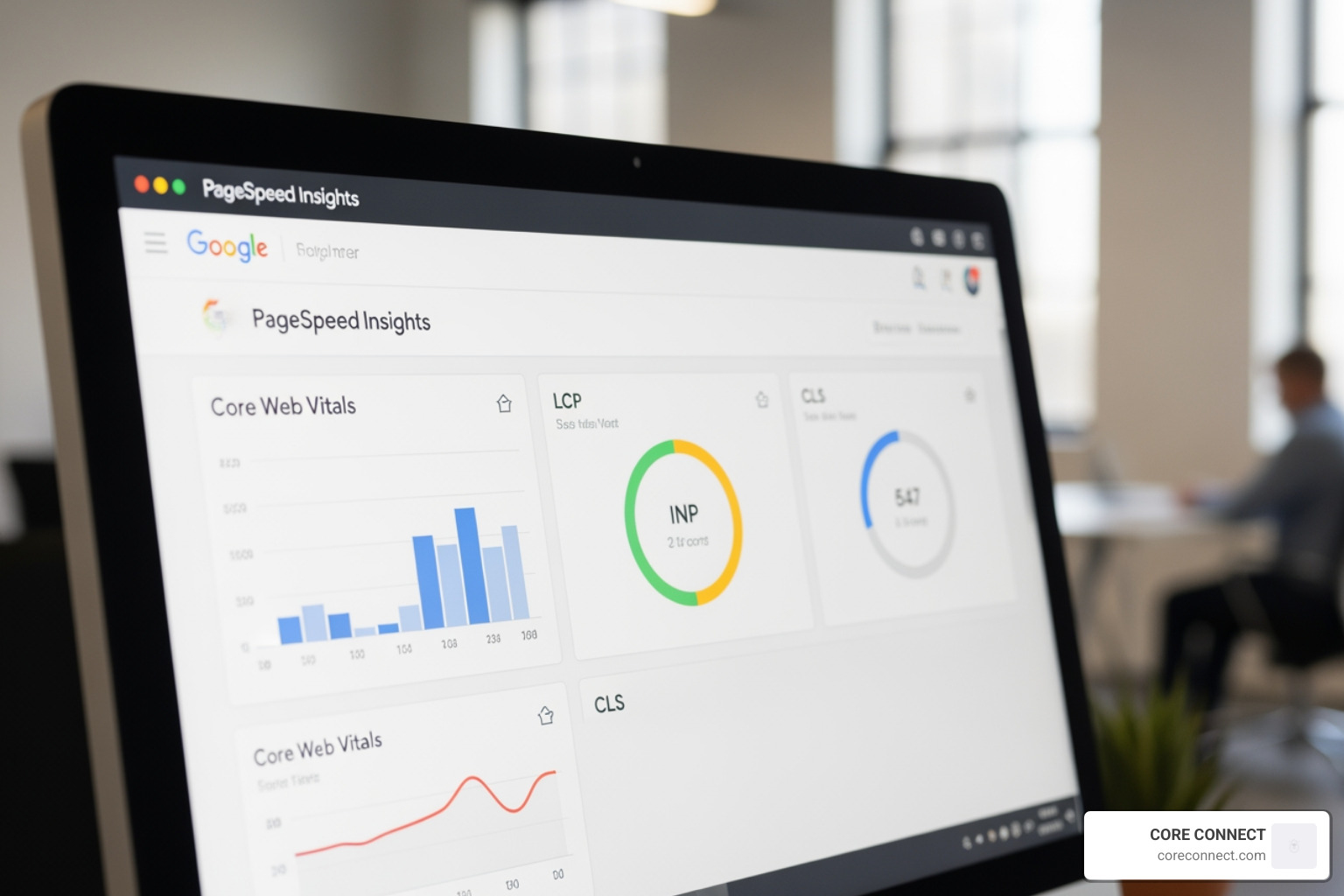
Speed is a feature. Statistics show that bounce rates increase by 32% when a page load time goes from 1 to 3 seconds. Google measures this through “Core Web Vitals,” a set of metrics that quantify the real-world user experience for loading performance, interactivity, and visual stability.
- Largest Contentful Paint (LCP): This measures how long it takes for the main content to load. Aim for under 2.5 seconds.
- Interaction to Next Paint (INP): This recently replaced First Input Delay (FID) and measures how quickly your site responds to a user’s click or tap.
- Cumulative Layout Shift (CLS): Have you ever tried to click a button, but the page shifted and you clicked an ad instead? That’s poor CLS.
To meet Google’s Core Web Vitals standards, we utilize techniques like browser caching (storing parts of your site on the user’s device), using Content Delivery Networks (CDNs) to serve content from servers closer to the user, and “minification” — the process of stripping unnecessary characters from your code to make it leaner.
The Role of Content in SEO Friendly Website Design
You’ve heard it before: Content is King. But in SEO friendly website design, content is more like the “vibe” and the “value” of the home. It needs to be high-quality and follow Google’s E-E-A-T principles: Experience, Expertise, Authoritativeness, and Trustworthiness.
Google’s human quality raters use Google’s Quality Evaluator Guidelines to determine if content is actually helpful to people. We don’t write for bots; we write for the people of South Carolina who are looking for solutions.
Content Hierarchy and Structure
- Header Tags: Use H1 for your main title, then H2 and H3 for subtopics. This acts as a table of contents for search engines.
- Keyword Integration: We research what your customers are actually typing into Google. We then weave these keywords naturally into your headers and body text. No “keyword stuffing” — it’s 2024, and Google is too smart for that.
- Thin and Duplicate Content: Every page should provide unique value. “Thin content” (pages with very little information) or “duplicate content” (copying text from other pages) can lead to ranking penalties.
If you’re struggling to articulate your brand’s value, our Website Design services focus on creating content that speaks to both your audience and the search algorithms.
Media Optimization and Visual Assets
Images and videos make your site engaging, but they can also be the heaviest part of your page.
- Compression: Never upload a 5MB photo straight from your camera. Use tools to compress images without losing quality. We recommend the WebP format, which is much smaller than traditional JPEGs.
- Alt Text: This is a short description of an image in the code. It helps visually impaired users and tells Google what the image is about.
- The Power of Video: Research shows that 89% of consumers want more video from brands. When embedding video, always provide transcripts for accessibility and SEO.
- Lazy Loading: This tells the browser to only load images as the user scrolls down to them, which significantly speeds up the initial page load.
Enhancing UX and Accessibility for Better Rankings
User Experience (UX) and SEO are two sides of the same coin. Google wants to rank websites that people enjoy using. If users land on your site and immediately “bounce” back to the search results, it tells Google your site wasn’t a good match.
Navigation and Clarity
Your User Interface (UI) should be intuitive. Menus should be clear, and buttons should be easy to tap on a mobile device. We aim for “predictable patterns” — users shouldn’t have to go on a treasure hunt to find your contact page.
Accessibility is Not Optional
Did you know that 1 billion people around the globe have disabilities that can affect how they browse the web? Inclusive design isn’t just the right thing to do; it’s good for business. By following WCAG 2.0 guidelines, you ensure that everyone can access your services.
- Color Contrast: Ensure text is easy to read against the background.
- Font Legibility: Use clean fonts and a minimum size of 16px for body text.
- Screen Reader Friendly: Proper use of alt text and header tags allows screen readers to navigate your site effectively.
When you combine a great user experience with Website Visitor Identification, you don’t just see that someone visited; you see exactly how they interacted with your design, allowing you to refine the experience even further.
Choosing the Right Tools and AI for Modern Design
The platform you choose to build your site on can either be a wind at your back or a weight around your neck.
| Platform | SEO Capability | Best For |
|---|---|---|
| WordPress | Excellent (with plugins) | Scalability and full control |
| Shopify | Good (e-commerce focus) | Online stores |
| Wix | Improved (great for basics) | Small brochure sites |
| Squarespace | Moderate | Portfolios and visual brands |
We often lean toward WordPress combined with Elementor for our Charleston clients because it offers a perfect balance of design freedom and deep SEO customization.
The Role of AI and Schema Markup
AI is revolutionizing SEO friendly website design. We use AI for automated content audits, keyword research, and even generating schema markup. Schema is a type of “structured data” that you add to your code to give search engines more context. For example, it can tell Google that a specific number is a price, or a string of text is a customer review. You can test your implementation using the Schema Markup Validator.
Modern design also uses AI for “adaptive layouts” that can change slightly based on user behavior and A/B testing to see which button color or headline performs better for conversions.
Frequently Asked Questions about SEO Friendly Web Design
Why is SEO friendly website design important for small businesses?
For small businesses in competitive areas like the Lowcountry, visibility is everything. A search-optimized site levels the playing field, allowing you to compete with larger national brands. It’s a cost-effective way to build brand authority and drive local search traffic. Unlike paid ads, which stop the moment you stop paying, an SEO-friendly site provides long-term, sustainable growth.
What are common mistakes to avoid during a website redesign?
The biggest mistake is the “splash page” — a landing page with just a logo and a “Click to Enter” button. These have almost no content for search engines to index. Other pitfalls include broken redirects (not telling Google where the old pages went), missing metadata, and ignoring your existing site audit data. Never start a redesign without knowing what is already working on your current site!
How does website security impact search rankings?
Security is about trust. Google announced HTTPS as a ranking signal years ago. Beyond the small ranking boost, a secure site reduces your bounce rate. If a user sees a “Not Secure” warning in their browser, they will likely leave immediately. Data encryption via SSL is basic cyber hygiene that protects both you and your customers.
Conclusion: Building for the Future with CORE CONNECT
At CORE CONNECT, we believe that your website should be your hardest-working employee. By integrating SEO friendly website design with our Reveal Marketing Hub, we provide Charleston businesses with a growth platform that goes far beyond aesthetics.
We combine conversion-focused design with marketing automation and real-time visitor intelligence. Our systems don’t just show you that you have traffic; they expose who is visiting, how they found you, and what actions they took. This turns anonymous data into usable sales insights.
Whether you need fully managed services or the professional-grade tools to run your own marketing in-house, we provide the clarity and control needed to scale. Don’t let your website be a “ghost town” in the search results. Start scaling your business with CORE CONNECT and turn your digital presence into an SEO superstar.