A Comprehensive Guide to Marketing Automation
Why Marketing Automation Has Become Essential for Growing Businesses
Marketing automation refers to software platforms that help businesses automate repetitive marketing tasks across multiple channels—email, SMS, social media, digital ads, and more—while tracking customer behavior and managing campaigns from a single system.
Quick Overview: What Marketing Automation Does
- Automates repetitive tasks like email sequences, lead scoring, and campaign management
- Integrates multiple channels (email, SMS, ads, social) into unified workflows
- Tracks customer behavior across all touchpoints to build a 360-degree view
- Streamlines handoffs between marketing, sales, and support teams
- Measures ROI through attribution reporting and conversion path analysis
- Personalizes at scale using behavioral triggers and dynamic content
The business case is straightforward. The B2B marketing automation market reached $2.74 billion in 2021, growing from $2.1 billion just one year earlier. That growth reflects a fundamental shift: businesses can no longer rely on manual processes to manage complex, multi-channel customer journeys.
Marketing automation solves a real problem. It consolidates fragmented tools, eliminates time-consuming manual tasks, and turns scattered customer data into actionable insights. Instead of juggling separate platforms for email, ads, CRM, and analytics, teams work from a unified system that tracks every interaction and triggers the right follow-up automatically.
The impact shows up in areas like lead generation, segmentation, nurturing, scoring, relationship marketing, cross-sell, retention, and ROI measurement. For businesses already investing in digital ads and SEO but struggling with inconsistent conversions or unclear attribution, automation provides the infrastructure to connect campaigns to revenue.
What used to require entire teams can now run in the background—lead handoffs, personalized email sequences, abandoned cart reminders, webinar follow-ups, and sales notifications—all triggered by specific customer actions. This frees teams to focus on strategy, content, and relationships rather than repetitive execution.
But automation isn’t just about efficiency. It’s about consistency. When done right, it ensures every lead receives timely, relevant communication regardless of volume. Whether you’re nurturing 100 prospects or 100,000, the experience remains personalized and seamless.
Privacy regulations like GDPR (effective May 2018) and CCPA (January 2020) have changed how automation platforms handle data. Businesses now need tools that support consent management, transparency, and first-party data collection—not just powerful workflows. The best platforms balance personalization with compliance.
I’m Stephen Sovenyhazy, founder of CORE CONNECT, where I’ve spent over 20 years building marketing automation systems that connect websites, CRMs, and organic strategies into unified platforms businesses actually own. Throughout this guide, we’ll walk through how marketing automation works, where it delivers the most value, and how to implement it without losing control of your data or customer relationships.
What is Marketing Automation and How Does It Work?
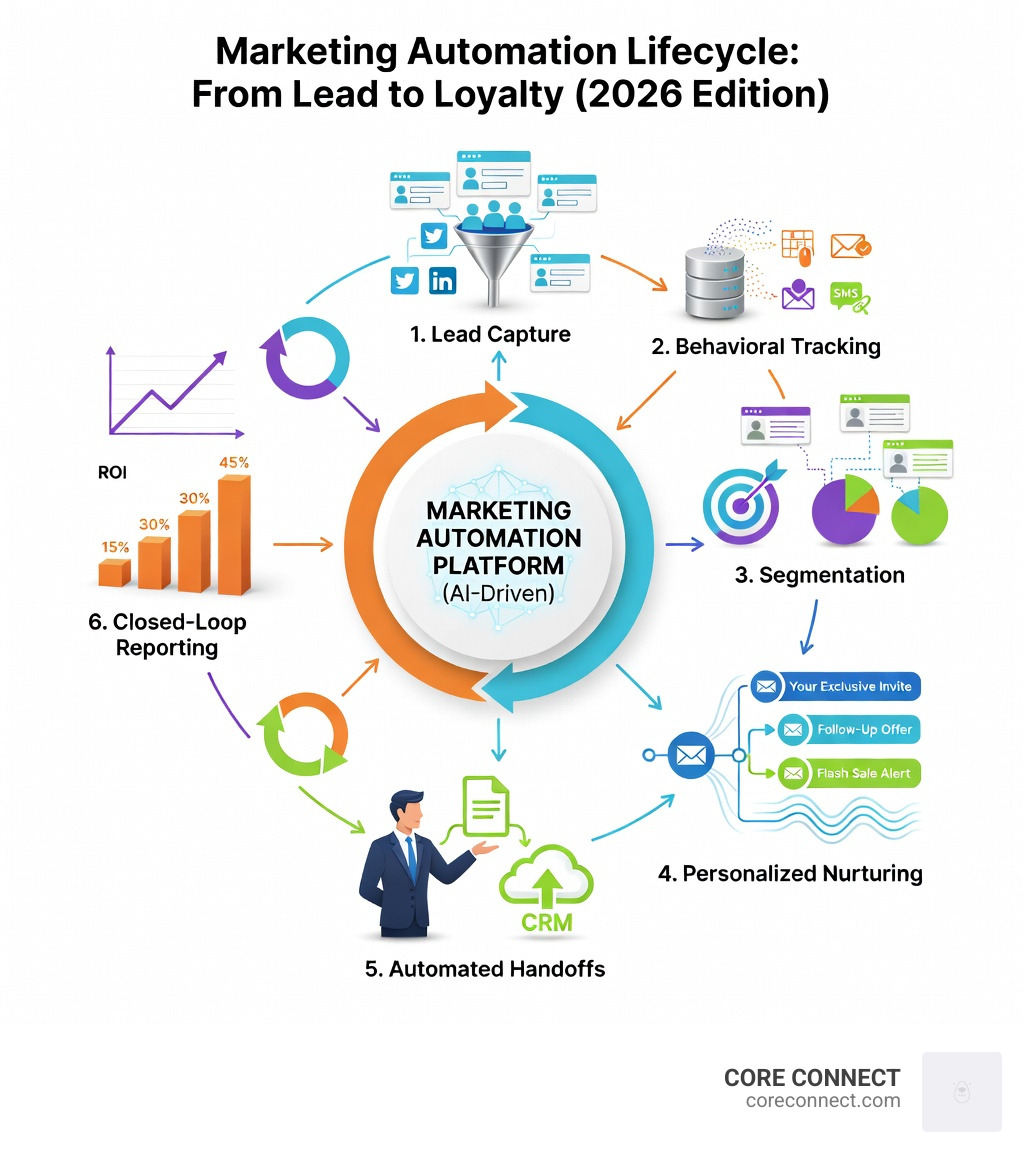
At its simplest, marketing automation is the use of software to handle the heavy lifting of modern marketing. Think of it as a digital “brain” that connects your website, your email list, your social media, and your sales team. Instead of manually checking who filled out a form or who clicked a link, the software does it for you—instantly and accurately.
According to research on what is marketing automation?, these systems are designed to automate repetitive tasks and consolidate multi-channel interactions. This includes tracking, lead scoring, and reporting into a single system. It essentially turns your marketing strategy into a self-sustaining engine.

The workflow usually begins with lead generation. When a visitor interacts with your site—perhaps by downloading a guide or signing up for a newsletter—the system captures their data. From there, it moves into campaign management, where the software decides what happens next based on the user’s behavior. If they clicked a link about SEO, they might receive an email marketing sequence specifically about search visibility.
Finally, all this data is stored in a data warehouse. This isn’t just a list of names; it’s a detailed history of every interaction a person has had with your brand, allowing you to see exactly which efforts are driving revenue.
Core Categories of Marketing Automation Software
Not all automation is created equal. To understand the landscape, we can break it down into four primary categories:
- Marketing Intelligence: This is the “listening” part of the software. it uses tracking codes to monitor social media threads, email clicks, and website behavior to gauge buyer intent.
- Lead Nurturing: This is the “talking” part. It includes tools for email marketing, lead scoring, and drip campaigns that move a prospect through the funnel.
- Advertising Automation: This handles the technical side of ads, such as generating tracking pixels, managing UTM parameters, and serving dynamic ads based on user history.
- Workflow Automation: These are internal processes, such as notifying a sales rep when a high-value lead visits the pricing page or automatically updating a CRM record.
The Strategic Benefits of Implementing Marketing Automation
Implementing marketing automation isn’t just about saving time; it’s about improving the bottom line. Research on the IMPACTS OF MARKETING AUTOMATION ON BUSINESS PERFORMANCE shows that these tools significantly boost efficiency and ROI by ensuring no lead falls through the cracks.
One of the most powerful features is lead scoring. Instead of your sales team calling every person who downloads a PDF, the system assigns points based on actions. A person who visits the pricing page three times gets a higher score than someone who just read a blog post. This allows your team to focus on the “hottest” opportunities first.
Furthermore, it enables relationship marketing at scale. You can maintain long-term connections with thousands of customers by sending them relevant content on their birthdays, purchase anniversaries, or when they haven’t engaged in a while. This level of scalability ensures that a business in Charleston or Mount Pleasant can provide the same “small-town” personal touch even as they grow into a regional powerhouse.
Streamlining Cross-Team Processes Between Sales and Support
One of the biggest friction points in any business is the handoff between marketing, sales, and support. Marketing automation acts as the glue between these departments.
- Automated Lead Handoffs: When a lead reaches a certain score, they are instantly routed to the right sales rep.
- Unified Customer Timeline: Sales reps can see every email the prospect opened and every page they visited before making the first call.
- Bi-Directional Sync: When a salesperson updates a status in the CRM, the marketing system knows to stop the “introductory” emails and start the “onboarding” sequence.
- Closed-Loop Reporting: Support teams can use automation to trigger retention campaigns if a customer submits a “help” ticket, ensuring a proactive response.
For more details on how this works in practice, you can explore CORE CONNECT CRM features.
Personalizing the Customer Journey at Scale
In the modern digital landscape, customers don’t just want personalization—they expect it. They don’t want to be treated like a number in a database; they want a journey that feels tailor-made for them.
Marketing automation makes this possible through behavioral triggers. If a customer abandons a shopping cart, the system can automatically send a reminder email with a special discount. If they spend five minutes on a specific service page, it can trigger a chatbot to offer a consultation.
This creates a 360-degree view of the customer. By combining data from email, website visits, and social media, you can deliver dynamic content—meaning two different people visiting your homepage might see two different offers based on their past interests. For those looking to go deeper, our guide to website visitor identification explains how we unmask anonymous traffic to fuel these personalized journeys.
Data-Driven Decision Making in Marketing Automation
Data is the fuel that powers the automation engine. Without it, you’re just guessing. Advanced Marketing Automation research highlights that the most successful companies use “Customer Intelligence” to maximize their returns.
Key metrics that automation provides include:
- Attribution Reporting: Knowing exactly which Facebook ad or SEO blog post led to a $10,000 sale.
- Engagement Scoring: Identifying which content topics are actually resonating with your audience.
- Conversion Path Analysis: Seeing the literal steps a customer took—from their first Google search to their final purchase.
Navigating Data Privacy and the Consumer Experience
As we collect more data to fuel our marketing automation, we must also be better stewards of that data. The landscape of privacy has shifted dramatically in recent years.
Regulations like the General Data Protection Regulation (GDPR) and the California Consumer Privacy Act (CCPA) have introduced strict rules. For businesses in the Lowcountry serving international or coastal clients, compliance isn’t optional. GDPR requires clear consent for data tracking, while CCPA grants consumers the right to opt-out and request data deletion.
The impact on the consumer experience is a double-edged sword. On the positive side, consumers get more relevant, helpful marketing. On the negative side, some feel a loss of consumer autonomy, as if an algorithm is making decisions for them. The key is transparency. By ensuring GDPR/CCPA compliance, we build trust. Trust leads to better data, and better data leads to more effective automation.
Marketing Automation in Action: Real-World Examples
To see how this works in the “real world,” let’s look at the difference between a manual workflow and an automated one.
| Task | Manual Process | Automated Process |
|---|---|---|
| New Lead Follow-up | Rep checks email, manually types a reply 4 hours later. | System sends “Welcome” email and SMS instantly. |
| Webinar Management | Manually adding RSVPs to a spreadsheet and emailing links. | Form submission triggers registration, calendar invite, and reminders. |
| Abandoned Cart | Rep notices a lost sale, tries to remember to email the user. | System detects the exit and sends a reminder 30 minutes later. |
| Lead Routing | Manager looks at leads once a day and assigns them to reps. | High-value leads are assigned via “Round Robin” the second they convert. |
Another great example is webinar nurturing. Instead of just hosting a one-off event, you can use CORE CONNECT automations to send invitations, manage RSVPs, deliver the “thank you” email with the recording, and then hand off the most engaged attendees to your sales team as “hot leads.”
Frequently Asked Questions about Automated Marketing
What is the current market size for B2B automation?
The B2B marketing automation market is booming. It was valued at $2.1 billion in 2020 and grew to over $2.74 billion in 2021. This growth is driven by the need for companies to manage complex, omnichannel strategies with smaller, more efficient teams.
How does technology impact the consumer experience?
It’s a mix of efficiency and personalization. Positively, it means customers get the information they need exactly when they need it. Negatively, if overdone, it can feel “spammy” or intrusive. The goal is to use automation to be helpful, not haunting.
What is the difference between CRM and automated platforms?
While they often work together, they have different jobs. Marketing automation focuses on the “top of the funnel”—getting leads, nurturing them, and tracking their behavior. A CRM (Customer Relationship Management) system focuses on the “bottom of the funnel”—managing the actual sales process, storing contact details, and tracking the deal through to the finish line.
Conclusion
Marketing automation is no longer a luxury reserved for giant tech firms. It is the essential infrastructure for any business in Charleston, Mount Pleasant, or the Lowcountry that wants to grow without burning out their team. By automating repetitive tasks, personalizing the customer journey, and bridging the gap between sales and marketing, you create a system that works for you 24/7.
At CORE CONNECT, we believe in giving you total clarity and control over this process. Whether you want us to manage it for you or you want to use our Reveal Marketing Hub to run your own high-performance campaigns, the goal is the same: sustainable growth built on real data.
Ready to see who is actually visiting your website and turn that traffic into revenue? Let’s build the system that takes your business to the next level.