Stop Sending Traffic to Your Homepage
Are You Sending Paid Traffic to the Wrong Page?
The difference between a landing page vs website comes down to one thing: purpose.
| Website | Landing Page | |
|---|---|---|
| Goal | Inform and explore | Convert one action |
| Pages | Many interconnected pages | Single standalone page |
| Navigation | Full menus and links | Minimal or none |
| Best for | Brand presence, SEO, trust | Ads, campaigns, lead gen |
| Traffic source | Organic, direct, referral | Paid ads, email, social |
In short: a website is your digital home base. A landing page is a focused conversion tool built for one specific goal.
Here’s a problem that comes up constantly with business owners in Charleston: they spend real money on Google Ads or Facebook campaigns, and all that traffic goes straight to their homepage. Visitors land, look around, get distracted by a blog post or an about page, and leave without doing anything. That’s not a traffic problem — that’s a page mismatch problem.
Most businesses have both a website and campaigns running. But few have the right page serving the right visitor at the right moment. The result? Wasted ad spend and leads that quietly disappear.
Understanding when to use each tool — and how to make them work together — is one of the highest-leverage decisions you can make for your marketing.
I’m Stephen Sovenyhazy, founder of CORE CONNECT, and over more than 20 years of building digital platforms across industries like healthcare, home services, and professional services, I’ve seen the landing page vs website confusion cost businesses thousands in preventable losses. In the sections ahead, I’ll break down exactly what each tool is, how they differ, and how to deploy them strategically so your marketing actually converts.
Defining the Digital Foundation: What is a Website?
When we talk about a website, we are referring to your business’s central hub on the internet. Think of it as your digital storefront or a permanent “stage” for your brand. For a professional services firm in Mount Pleasant or a home contractor in Summerville, a website is where you establish long-term authority and trust.
A website is a collection of interconnected web pages hosted under a single domain. It is designed for exploration. Visitors come here to learn about your history, browse your full catalog of services, read your blog, and find your contact information.
Core Components of a Website
- The Homepage: Your “welcome mat” that introduces the brand and directs traffic to various sections.
- Navigation Menus: The roadmaps (headers and footers) that allow users to jump between the “About Us,” “Services,” and “Contact” pages.
- Deep Content: This includes service catalogs, case studies, and blogs that provide value and help you rank for a wide variety of keywords.
- Interactivity: Portals for customer support, appointment scheduling, or e-commerce checkouts.
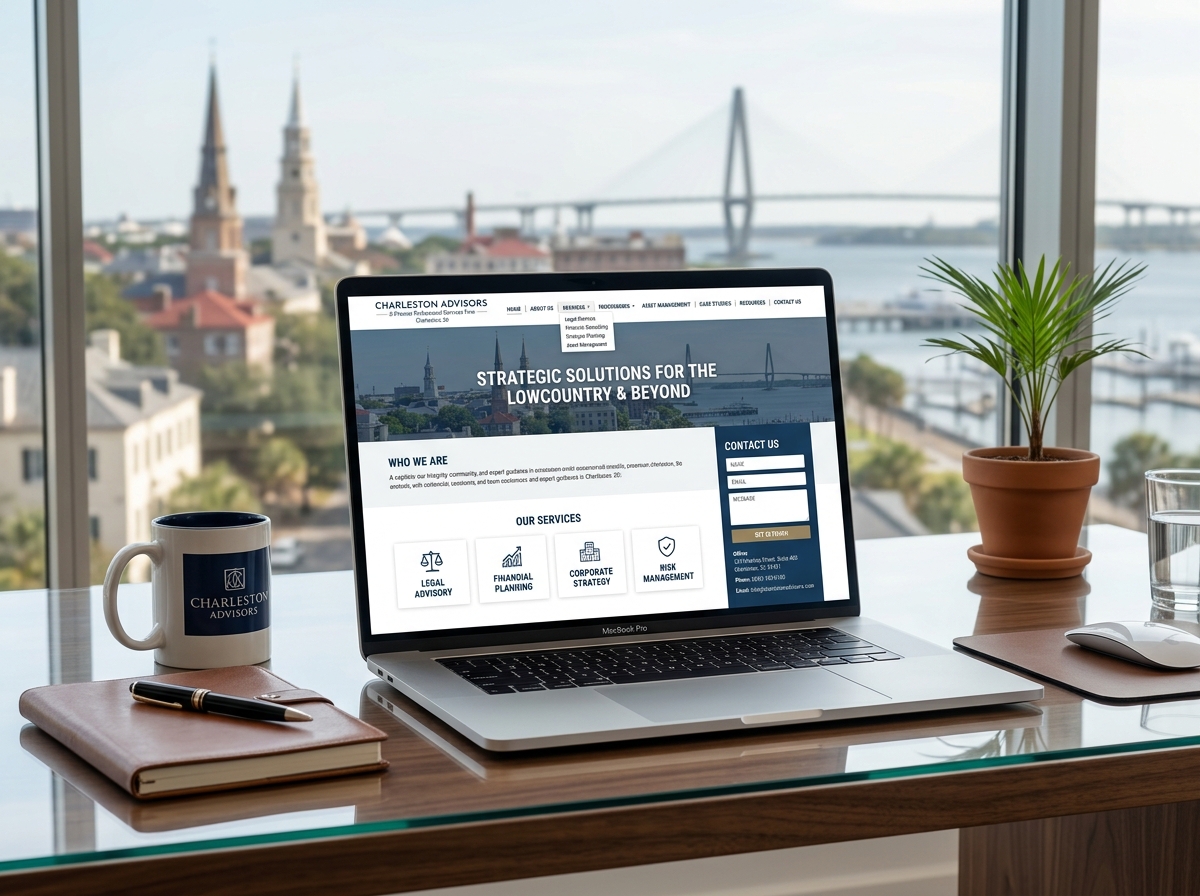
One critical aspect of a website is its role in building credibility. Research shows that websites appearing on the first page of search results are often perceived as more trustworthy by visitors. However, that trust is fragile. According to research on website load expectations by KissMetrics, 47% of consumers expect a website to load in 2 seconds or less, and 40% will bounce if it takes more than 3 seconds. In our Lowcountry market, a slow website is essentially a closed door.
At CORE CONNECT, we view the website as the foundation of your digital ecosystem. It is where you host your “Reveal Marketing Hub” to identify anonymous visitors and turn them into long-term assets. While it’s great for building a brand, it isn’t always the best tool for a high-speed sales sprint. That’s where the landing page comes in.
The Surgical Tool: Understanding the Landing Page
If a website is a multi-room house, a landing page is a single, focused room designed for one specific conversation. It is a standalone web page created specifically for a marketing or advertising campaign.
The “surgical” nature of a landing page means it has a single goal, known as a Call to Action (CTA). Whether you want someone to download a lead magnet, register for a webinar, or request a quote for HVAC repair in North Charleston, the landing page is stripped of anything that doesn’t lead to that goal.
Why Landing Pages Are Different
- Single Focus: There are no navigation menus to “leak” traffic. If a visitor lands there, they have two choices: convert or leave.
- Message Matching: The content on the page perfectly mirrors the ad or email that brought the visitor there. If your ad promises “15% off Roof Repairs in West Ashley,” the landing page talks only about that offer.
- Lead Magnets: They often use “gated content” (like a downloadable guide or coupon) to collect visitor information in exchange for value.
- Minimal Distractions: By removing the “About Us” links and social media icons, you keep the visitor’s attention locked on the conversion.
We often tell our clients that sending paid traffic to a homepage is like inviting someone to a party and then walking away; sending them to a landing page is like sitting down for a focused, one-on-one meeting. For those looking to refine their digital presence, you can find more info about our website design services to see how we integrate these focused tools into a broader strategy.
Landing page vs website: Key Differences in Conversion and Design
Understanding the landing page vs website debate requires looking at the data. The design principles for each are fundamentally different because their success is measured by different metrics.
| Feature | Website | Landing Page |
|---|---|---|
| Attention Ratio | High (many links/options) | 1:1 (one goal, one link) |
| Navigation | Extensive (Menu, Footer, Sidebar) | None or very minimal |
| Content Depth | Broad and comprehensive | Specific and persuasive |
| User Path | Self-directed exploration | Guided tour to conversion |
| Primary Metric | Time on site, pages per session | Conversion rate (leads/sales) |
Visual Hierarchy and Social Proof
On a website, visual hierarchy is used to help people find information. On a landing page, it is used to drive action. We use bold headlines, high-contrast CTA buttons, and “trust signals” like testimonials or local certifications right next to the signup form.
Research from Marketing Experiments suggests that the human brain processes visual content 60,000 times faster than text. This is why landing pages rely heavily on striking visuals and concise copy—ideally written at a 5th-to-7th grade reading level—to ensure the message hits home instantly.
Statistics show that businesses using both websites and dedicated landing pages achieve significantly better marketing results. In fact, companies with 10 to 15 landing pages see a 55% increase in leads, and those with more than 40 landing pages can generate 12X more leads. This is because multiple pages allow you to segment your audience and speak directly to their specific needs.
To ensure your landing pages aren’t just pretty but also discoverable, you can learn more about our SEO strategies to see how we balance conversion with search visibility.
Strategic Deployment: When to Choose Each Tool
Choosing between a landing page vs website isn’t about which is “better”—it’s about which is right for your current objective. At CORE CONNECT, we build integrated digital ecosystems where both tools play distinct roles.
When to Prioritize Your Website
- Building Brand Authority: You want to show the full scope of your business, your team, and your values.
- Educational Resources: You are providing blogs, tutorials, or knowledge resources to nurture long-term leads.
- Complex Product Lines: You have a SaaS platform or a retail store with hundreds of items that require a searchable catalog.
- Customer Support: You need a hub for FAQs, contact forms, and account logins.
When to Use a Landing Page
- Paid Advertising (PPC): Sending Google or Facebook ad traffic to a dedicated page can dramatically improve ROI by eliminating “conversion leaks.”
- Product Launches: You are introducing one specific new service and want to highlight its benefits without distraction.
- Lead Generation: You are offering a specific “lead magnet,” like an ebook or a free consultation for Charleston homeowners.
- Event Registrations: You need a simple way for people to sign up for a webinar or local workshop in Daniel Island.
Choosing between a landing page vs website for specific campaigns
For targeted messaging, the landing page is the undisputed king. If we launch an email marketing campaign for a client’s new “Review Response Service,” we don’t send those clicks to the homepage where they might get lost looking at the “Careers” section. We send them to a page designed only to explain and sell that one service.
This creates a “cohesive experience” where the interest expressed in the email is immediately satisfied by the page content. This alignment is why landing pages can increase conversion rates by up to 20% compared to homepages for targeted campaigns.
How do a landing page vs website impact my local SEO differently?
This is where many business owners get confused. Websites are your primary tool for organic visibility. They build “Domain Authority” over time through consistent blogging, internal linking, and mobile-friendly design. Google’s mobile-first indexing means your entire site must perform flawlessly on smartphones to rank well in Charleston local searches.
Landing pages, however, are often “momentary spotlights.” While they can be optimized for specific, high-intent keywords (like “emergency plumber Isle of Palms”), they are frequently kept “no-index” if they are part of a temporary paid campaign. This prevents them from competing with your main website pages in search results.
The key is integration. Your website provides the broad SEO foundation, while your landing pages capture the high-intent traffic from specific search modifiers.
Frequently Asked Questions
Can a landing page function as a standalone online presence?
Yes, particularly for a Minimum Viable Product (MVP) validation or a single-product business. If you are a specialized consultant or a startup testing a new concept in the Lowcountry, a single-page website (which is essentially a long-form landing page) can work. However, as you grow, you will eventually need the depth and SEO benefits of a full website. For those looking to scale, more info about the Reveal Marketing Hub can show you how to manage these leads as they grow.
Why are landing pages more effective for driving specific conversions?
It comes down to the “Attention Ratio.” On a homepage, the ratio might be 40:1 (40 links to 1 conversion goal). On a landing page, it is 1:1. By reducing friction and using psychological triggers like urgency (e.g., “Offer ends Friday!”) and social proof (local testimonials), you guide the visitor toward a single decision point.
What is the relationship between a homepage and a landing page?
Think of your homepage as the “welcome mat” and your landing page as the “guided tour.” A homepage introduces your brand to anyone who walks by. A landing page takes a specific person by the hand and leads them to a specific destination. If your “welcome mat” is too cluttered, people get confused and leave—that’s a conversion leak.
Conclusion: Building Your Integrated Digital Ecosystem
The debate of landing page vs website shouldn’t be an “either/or” scenario. To truly dominate the Charleston market, you need both working in harmony. Your website builds the trust, authority, and SEO foundation you need for long-term growth. Your landing pages act as the high-precision tools that turn your advertising dollars into measurable ROI.
At CORE CONNECT, we don’t just build “sites.” We build operating systems for growth. By using our Reveal Marketing Hub, we help you identify who is visiting your pages, capture their interest through focused landing pages, and automate the follow-up so no lead falls through the cracks. We move you away from fragmented, “leaky” marketing and toward a unified platform that you own and control.
Stop letting your hard-earned traffic disappear into the chaos of a generic homepage. It’s time to build a scalable, data-driven foundation for your business.
Ready to stop the leaks and start growing?
- Schedule a Free Consultation to discuss your digital strategy.
- Book a 30-Minute Discovery Call with our team.
- Get Your Free Digital Audit to see where your current site is losing leads.
Contact us today:
Phone: +1 (843) 800-2026
Email: hello@coreconnect.com
Start building your integrated foundation and take ownership of your business growth in the Lowcountry and beyond.