
How to Stop Begging for Leads and Start Generating Them
Why Most Businesses Struggle to Improve Lead Generation (And What Actually Works)
Improve lead generation and you fix one of the most common problems businesses face online: spending money on traffic that never converts.
Here’s a quick breakdown of the most effective ways to do it:
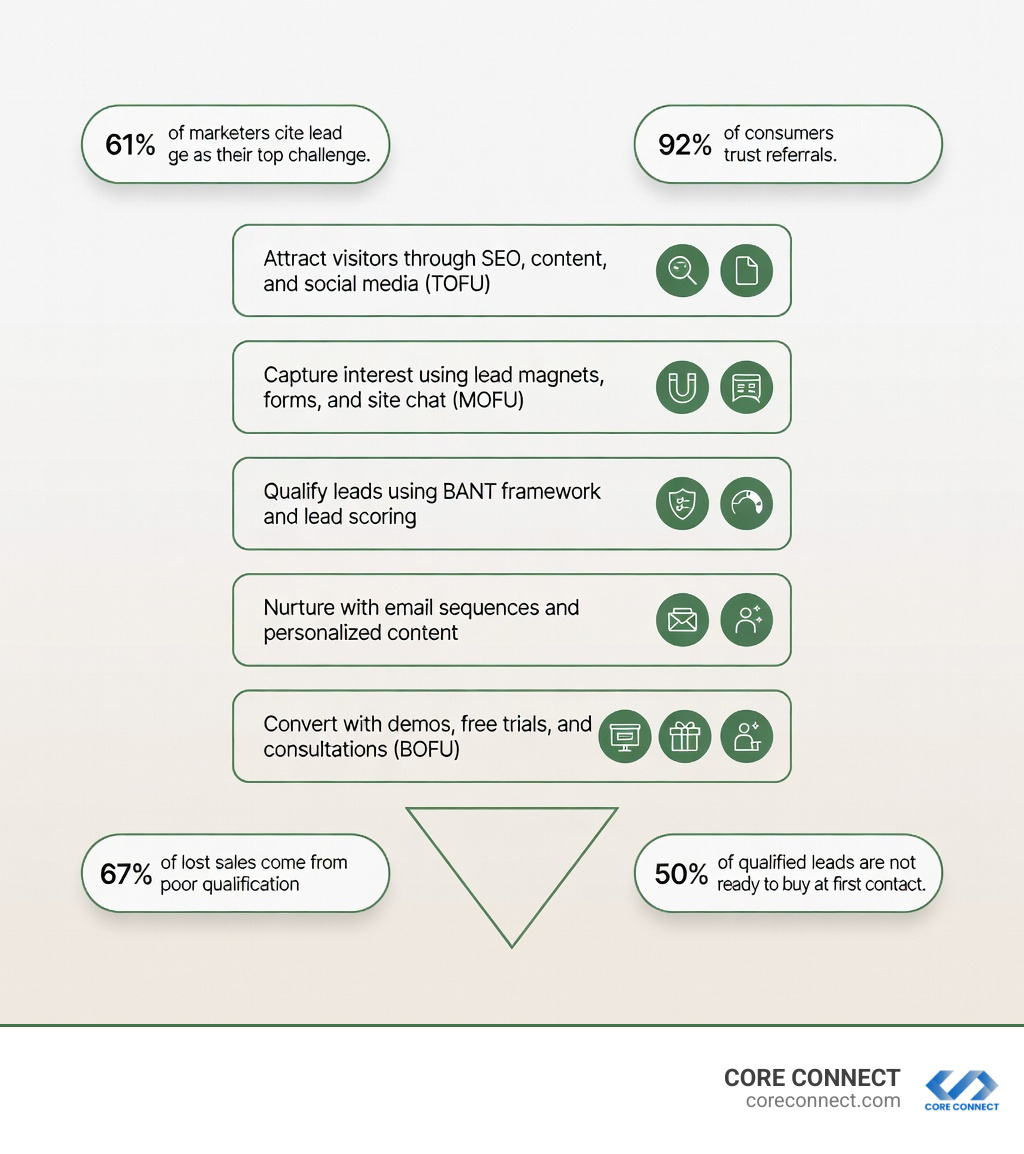
- Define your funnel – Know your TOFU, MOFU, and BOFU stages
- Create targeted content – Match content to each stage of the buyer journey
- Optimize lead capture – Shorter forms, smart CTAs, and site chat
- Qualify leads early – Use BANT and lead scoring to focus sales effort
- Leverage SEO and intent data – Attract buyers who are already looking
- Build referral systems – Activate your existing customers as a lead source
- Align sales and marketing – Shared definitions and shared data
You’re not alone if your website is getting traffic but not generating consistent leads. According to research, 61% of marketers say generating traffic and leads is their single biggest challenge. And 80% say their lead generation efforts are only slightly or somewhat effective.
The problem usually isn’t effort. It’s foundation.
Most businesses skip the fundamentals – no clear funnel, no defined buyer persona, no system for capturing or qualifying interest. They run ads, post on social media, and wait. Then wonder why the pipeline is dry.
Lead generation isn’t about doing more. It’s about doing the right things in the right order.
I’m Stephen Sovenyhazy, founder of CORE CONNECT, and over more than 20 years of building and scaling digital platforms across industries like healthcare, fitness, marine, and professional services, I’ve seen how a structured, system-driven approach to improve lead generation transforms inconsistent pipelines into predictable growth engines. In this guide, I’ll walk you through exactly how to build that system – step by step.
The Foundation: Why You Must Improve Lead Generation
Lead generation is the lifeblood of any growing business, especially here in competitive markets like Charleston and Mount Pleasant. It is the strategic process of identifying, attracting, and converting anonymous web visitors into people who have expressed a genuine interest in your products or services. Without it, your sales team is essentially “begging” for business rather than managing a predictable pipeline.
The stakes are high. As mentioned, 61% of marketers identify lead generation as their number one challenge. Even more concerning is the “effectiveness gap”: 80% of marketers feel their efforts are only slightly or somewhat effective. This usually happens because businesses rely on outdated outbound tactics—like cold calling or generic “blast” emails—that feel disruptive to the modern buyer.
To truly improve lead generation, we must shift toward an inbound methodology. This means creating valuable content and experiences tailored to your audience, building credibility before a sales conversation even begins. When you provide value first, you stop chasing leads and start attracting them. For a deeper dive into how these pieces fit together, explore our guide on Marketing Strategies Guaranteed to Grow Your Business.
Understanding the Modern Lead
Not all leads are created equal. To manage your time effectively, you need to categorize them based on their “readiness” to buy:
- Marketing Qualified Lead (MQL): These are folks who have engaged with your marketing efforts—perhaps by downloading a guide or signing up for a newsletter—but aren’t quite ready for a sales call. They fit your target criteria but need more nurturing.
- Sales Qualified Lead (SQL): These leads have taken actions that indicate a high intent to buy, such as requesting a demo or a pricing quote. They are ready for direct follow-up from your sales team.
- Product Qualified Lead (PQL): Common in SaaS, these are users who have used a free version of your product and performed actions that signal they are ready to become paying customers.
- Service Qualified Lead: These are existing customers who indicate to your service or support team that they are interested in upgrading or adding new services.
Inbound vs. Outbound Strategies
The primary difference lies in how you initiate the relationship. Outbound is “disruptive”—think TV ads, cold emails, or door-to-door sales. While it can still work, it often lacks the trust required for high-value B2B sales.
Inbound is “permission-based.” By using SEO, helpful blog posts, and social media engagement, you attract prospects who are actively searching for solutions to their problems. In 2025, the most successful businesses use a “hybrid” approach, but lead with inbound value to build a foundation of trust.
Mapping the Journey: The Lead Generation Funnel
If you don’t know where your leads are in their journey, you can’t give them what they need to move forward. Surprisingly, 68% of companies haven’t even identified their sales funnel yet. This is a massive missed opportunity, especially considering that 48% of companies report that leads require a long sales cycle before purchasing.
Furthermore, 50% of qualified leads aren’t ready to purchase at first contact. A well-defined funnel ensures you don’t scare them away by asking for a “marriage” (a sale) on the “first date” (initial visit).
| Funnel Stage | Goal | Content Types |
|---|---|---|
| TOFU (Top) | Awareness | Blogs, Social Media, Infographics, Videos |
| MOFU (Middle) | Consideration | Webinars, Case Studies, Whitepapers, eBooks |
| BOFU (Bottom) | Decision | Demos, Free Trials, Pricing Pages, Consultations |
Top of the Funnel (TOFU): Awareness
At this stage, your prospect is experiencing a problem or a “pain point” but might not know your brand exists. Your job isn’t to sell; it’s to educate. If you are a home service provider in the Lowcountry, you might write a blog post about “How to Protect Your HVAC System During Charleston Summers.” You are solving a problem and establishing expertise.
Middle of the Funnel (MOFU): Consideration
Now the prospect knows they have a problem and are evaluating different solutions. They are looking for proof that you can help. This is where case studies (which rank third in top-used B2B content types) and webinars become vital. They allow you to showcase real-world results and build deeper trust.
Bottom of the Funnel (BOFU): Decision
The prospect is ready to pick a winner. They are looking at your pricing page, checking out your reviews (95% of consumers read reviews before buying), and comparing you to competitors. High-friction offers like a “Live Demo” or “Free Consultation” are appropriate here because the intent is high.
High-Impact Strategies to Improve Lead Generation in 2025
To stay ahead in South Carolina’s growing business landscape, you need more than just a “digital brochure” website. You need a lead-generating machine.
With Google handling over 8.5 billion searches a day, your Search Engine Optimization is the bedrock of your lead gen. But don’t forget the mobile experience: 40% of consumers will turn to a competitor after a poor mobile experience. Additionally, face-to-face interaction still reigns supreme in B2B; 70% of marketers say live events are crucial to their success.
Using SEO and Content to Improve Lead Generation
To improve lead generation via search, you must go beyond basic keywords. You need “10x content”—content that is ten times better than anything else currently ranking for your target terms.
Interactive elements are a secret weapon here. Research shows that 81% of marketers agree interactive content (like quizzes or calculators) is more effective at grabbing attention than static content. Combine this with personalization—which 70% of B2B marketers are already doing—and you create a website experience that feels tailored to the individual visitor’s needs.
Social Selling and LinkedIn Authority
LinkedIn has grown to over 1 billion users, including 61 million senior-level influencers and 40 million decision-makers. It is no longer just a place for resumes; it’s a B2B powerhouse. In fact, 55% of decision-makers use LinkedIn to vet companies before doing business with them.
We recommend focusing on “Social Selling”—building a personal brand and sharing helpful insights rather than sending cold DMs. By positioning yourself as a thought leader, you pull leads toward you. For more on this, check out our insights on Social Media Marketing.
Advanced Capture and Qualification Techniques
Getting people to your site is only half the battle. You have to capture their information. This is where most businesses fail: 81% of people have abandoned a form after starting to fill it out.
The average lead capture form has five fields, but studies show that the fewer fields you use, the higher the conversion rate. If you can’t get a form fill, don’t panic. Tools like Website Visitor Identification can tell you which companies are visiting your site even if they don’t sign up. This is critical because 67% of lost sales result from poor qualification—spending time on the wrong people.
Mastering Lead Capture Forms and Pop-ups
To reduce friction, keep your forms short. Use “exit-intent” pop-ups that only appear when someone is about to leave your site—these can have conversion rates around 3.09%. Use conditional logic to only ask relevant questions, and always use personalized CTAs. Personalized calls-to-action convert 202% better than generic ones!
Site chat is another major preference; 42% of people prefer connecting via chat over phone or email. It provides immediate answers and can act as a 24/7 lead capture tool using automated chatbots.
Qualifying Leads to Protect Sales Time
Your sales team’s time is expensive. Don’t waste it on leads that aren’t a fit. Use the BANT framework to qualify:
- Budget: Can they afford your solution?
- Authority: Are you talking to the decision-maker?
- Need: Does your product solve a specific pain point they have?
- Timing: Are they looking to buy in the next 3-6 months?
By combining this with lead scoring—assigning points for actions like visiting your pricing page—you ensure your team only calls the hottest prospects. To understand the full power of this data, see the Benefits of Website Visitor Identification.
Scaling Results: Email, Referrals, and Intent Data
Once you have a lead, the work isn’t done. You must nurture that relationship. Email marketing remains a top channel, with 34.49% of companies leveraging it for lead gen.
But perhaps the most overlooked strategy is referrals. A staggering 92% of consumers trust referrals from friends, and referred customers have a 16% higher lifetime value. Yet, only 11% of sales professionals actually ask for them. If you want to improve lead generation quickly, start by asking your happy customers for an introduction. Learn more about our approach to Email Marketing and why 92% of consumers trust referrals from friends.
Leveraging Intent Data to Improve Lead Generation
Intent data is the “crystal ball” of modern marketing. It tells you which companies are actively researching your services across the web—not just on your site. Currently, 99% of large companies use intent data, and 98% of marketers feel confident in its accuracy. With 70% of businesses planning to increase their spend on intent data, it’s clear that knowing who is in-market before they even contact you is the future of B2B growth.
Referral Programs and Co-Marketing
Since 84% of buyers start the sales process with a referral, building a formal program is a no-brainer. You can also leverage co-marketing—partnering with a non-competing business that shares your target audience (like a web designer partnering with an SEO agency) to host webinars or swap guest blog posts. This allows you to tap into an already-established well of trust.
Frequently Asked Questions about Lead Generation
What is the difference between lead generation and demand generation?
Demand generation is about creating brand awareness and interest in your category (e.g., “Why you need digital marketing”). Lead generation is the specific process of capturing contact information from those interested parties (e.g., “Download our SEO checklist”). You need demand gen to fill the top of the funnel so you have leads to capture.
How long does it take to see results from a lead generation campaign?
It depends on the channel. Paid ads (PPC) can generate leads almost instantly. However, SEO and content marketing typically take 3 to 6 months to gain significant traction. For B2B sales, over 30% of sales take one to three months to close, so patience and consistent nurturing are key.
What are the most common lead generation mistakes to avoid?
The biggest mistakes include:
- Asking for too much information too early (long forms).
- Not following up quickly (leads go cold in minutes, not days).
- Treating all leads the same (failing to qualify or score them).
- Ignoring mobile optimization (losing 40% of your audience).
- Buying lead lists (which leads to spam flags and low-quality prospects).
Conclusion
To improve lead generation in 2025, you need to stop thinking about marketing as a series of “one-off” campaigns and start thinking about it as a unified system. At CORE CONNECT, we help businesses in Charleston and across South Carolina build that exact system.
Through our proven marketing strategies and the Reveal Marketing Hub, we give you total clarity. By combining website design, SEO, and marketing automation with real-time visitor intelligence, we expose exactly who is on your site and what they care about. Whether you want us to manage the entire process for you or you want to use our professional-grade tools in-house, we provide the visibility you need to turn anonymous traffic into real revenue.
Stop guessing where your next customer is coming from. Start generating them with data-driven precision. Reach out to us today to see how we can help you scale with control.