Why Automated Marketing Workflows Are Now Essential for Growth
Automated marketing workflow systems are changing how businesses engage customers, qualify leads, and drive revenue. At their core, these workflows use triggers and actions to deliver personalized experiences at scale—without requiring manual intervention at every step.
Quick Overview: What You Need to Know
- Definition: A series of marketing tasks that execute automatically based on specific conditions or behaviors (like form submissions, email opens, or website visits)
- Key Components: Triggers, actions, data integration, lead scoring, and multi-channel orchestration
- Primary Benefits: 320% more revenue from automated emails, faster pipeline progression, and reduced manual workload
- Common Use Cases: Welcome sequences, cart recovery, lead nurturing, re-engagement campaigns, and cross-sell workflows
- AI Improvement: Natural language processing analyzes sentiment and intent, while predictive models forecast buyer behavior before it appears in your CRM
Why This Matters Now
Most marketing teams sit on a goldmine of customer data—website visits, email engagement, CRM notes, call transcripts—but never operationalize it. Traditional automation follows rigid “if this, then that” rules. AI-driven workflows adapt in real time, analyzing hundreds of variables simultaneously to make judgment calls that used to require human intervention.
The gap between companies using basic automation and those leveraging AI is widening fast. Businesses implementing advanced workflows report 49x ROI on cart recovery campaigns, 20% shorter sales cycles, and 25% increases in customer lifetime value.
Yet only 28% of marketers say their automation “very successfully” supports their objectives. The difference isn’t the platform—it’s the strategy behind it.
My Experience with Automated Marketing Workflows
I’m Stephen Sovenyhazy, founder of CORE CONNECT, and I’ve spent over 20 years building digital platforms and automated marketing workflows for businesses across healthcare, marine, fitness, and professional services. I’ve seen how businesses locked into expensive ad dependency and fragmented tools struggle—until they build workflows they actually own and control.
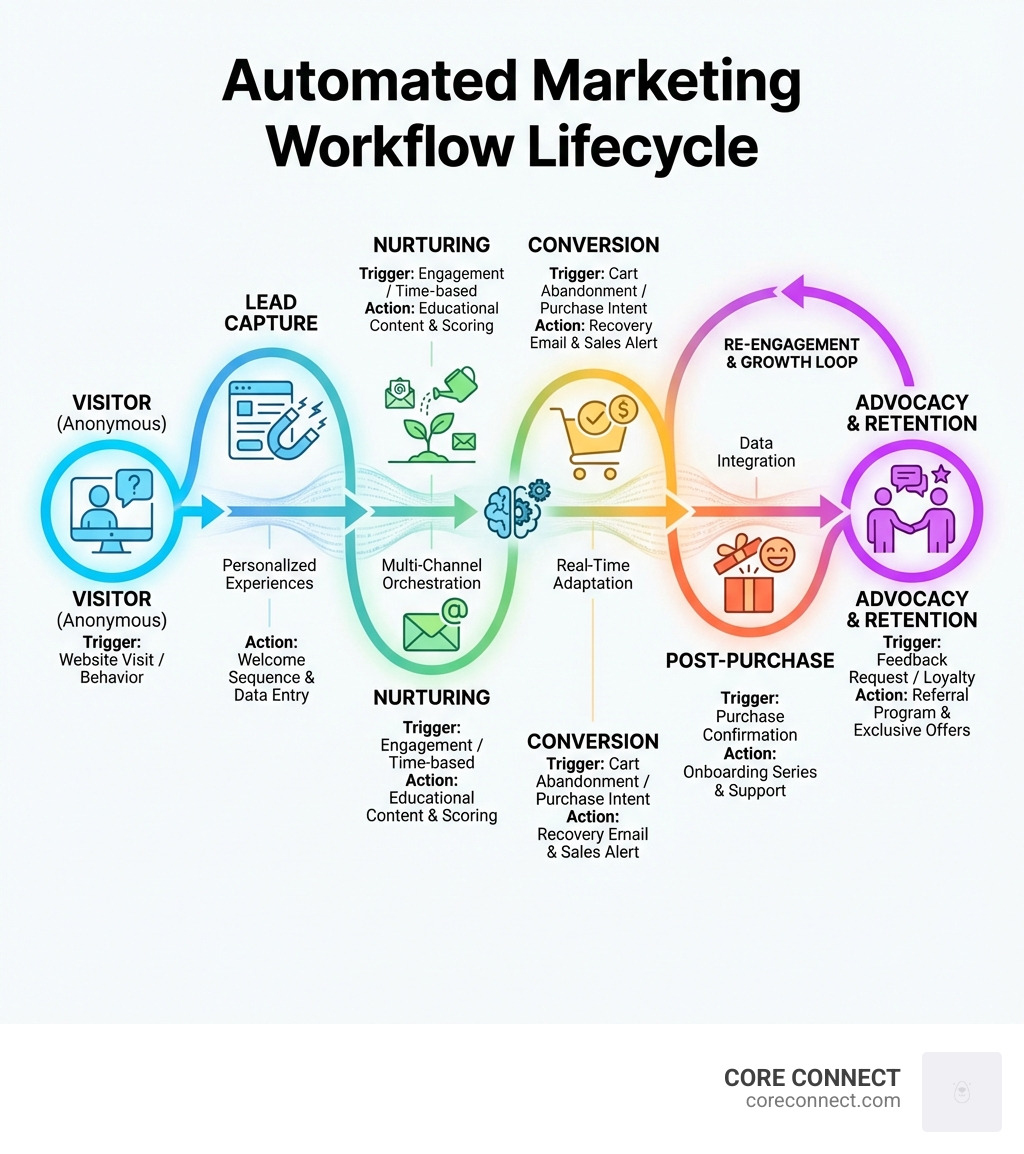
This infographic shows the complete customer journey powered by automated workflows: from anonymous website visitor → lead capture → nurturing sequence → conversion → post-purchase engagement → advocacy. Each stage includes specific triggers (form submission, cart abandonment, purchase confirmation) and corresponding automated actions (welcome email, recovery sequence, onboarding series) that guide prospects through the funnel without manual intervention.
The Anatomy of a High-Performing Automated Marketing Workflow
When we talk about an automated marketing workflow, we aren’t just talking about a single “thank you” email. We are describing a connected system that lives and breathes with your customer’s behavior. Think of it as a digital employee that never sleeps, never forgets a follow-up, and perfectly executes your brand voice every time.

At CORE CONNECT, we believe the best workflows are built on a foundation of clarity. If you can’t see where your leads are coming from, you can’t automate their journey effectively. This is why our Reveal Marketing Hub unifies your CRM, email, and SMS follow-up into one shared source of truth.
Core Components of an Automated Marketing Workflow
To build a workflow that actually moves the needle, you need four specific building blocks:
- Enrollment Triggers: This is the “if” in your “if-this-then-that” logic. It could be a contact clicking a link in an email, a specific form submission, or a visitor spending more than two minutes on your pricing page.
- Workflow Actions: These are the “then” steps. Actions include sending an email marketing campaign, assigning a task to a sales rep, or updating a lead score in your CRM.
- Data Unification: For automation to work, your tools must talk to each other. AI workflow automation unifies your CRM, website analytics, and intent data so marketing and sales operate from a single dashboard.
- Loop or Exit Points: Every good workflow needs an “off-ramp.” If a customer makes a purchase, they should immediately be unenrolled from the “nurture” sequence and moved into the “onboarding” sequence.
By using marketing automation through Reveal, we help businesses in the Lowcountry see exactly which triggers are turning anonymous visitors into paying clients.
Strategic Benefits Across Departments
Automation isn’t just for the marketing team. When implemented correctly, it creates a ripple effect of efficiency across your entire organization:
- Sales Efficiency: We’ve seen automated workflows lead to a 20% reduction in sales cycle length. By eliminating manual data entry and automating lead qualification, your reps can focus on building relationships rather than chasing cold leads.
- IT Operations: Automated workflows make it easy for IT to resolve support tickets quickly and keep software secure and compliant.
- HR Onboarding: You can deliver a connected employee experience by automating the delivery of training materials and benefits enrollment.
- Customer Service: Teams use workflows to scale customer experiences, ensuring that every support request is tracked and followed up on instantly.
- Revenue Acceleration: Because automated emails drive 320% more revenue than non-automated ones, the impact on your bottom line is immediate and measurable.
Categorizing Workflows by Business Goal and Complexity
Not all workflows are created equal. Some are “set it and forget it” simple, while others are complex, multi-channel engines.
Simple vs. Advanced Automated Marketing Workflow Examples
Simple Workflows (The Foundational Wins)
- Welcome Sequences: Triggered when a new lead joins your list. Instead of one generic email, send a personalized three-step series. One brand saw a 104% jump in first purchases just by adding personalization to their welcome flow.
- Cart Recovery: This is the “low-hanging fruit” of eCommerce. Cart recovery campaigns have produced a staggering 49x ROI in just eight weeks for some brands.
- Order Confirmations: Don’t just send a receipt; use this as an opportunity to provide helpful onboarding content or a “frequently bought together” recommendation.
Advanced Workflows (The Growth Engines)
- Predictive Segmentation: Using AI to identify customers with a “high discount affinity” and only sending coupons to those who actually need them to convert.
- Re-engagement Sequences: Automatically identifying subscribers who haven’t opened an email in 60 days and sending a “we miss you” offer to win them back or clean your list.
- Multi-Threaded Buying Patterns: In B2B, AI can correlate behavior across multiple users at the same company. If a Marketer downloads an ebook and a VP visits the pricing page, the AI recognizes “buying momentum” and alerts your sales team immediately.
Cross-Channel Orchestration Strategies
Modern customers move between devices and platforms. Your automated marketing workflow should too.
- SMS & WhatsApp: Slazenger used WhatsApp to achieve an 80% open rate and a 5x ROI on their cart abandonment campaigns.
- Web Push Notifications: Marks & Spencer used push notifications to achieve a 15.1% cart recovery rate—far higher than the 3% industry average for email.
- Social Media: Automatically flagging high-priority brand mentions for your team to respond to can save hours of manual scrolling.
How AI Agents Outperform Traditional Rule-Based Automation
Traditional automation is like a train on a track—it can only go where the rails are laid. AI agents are more like a self-driving car; they see the obstacles, understand the context, and change course to reach the destination faster.
| Feature | Traditional Automation | AI-Driven Automation |
|---|---|---|
| Logic | Static “If/Then” rules | Dynamic predictive modeling |
| Data Usage | Structured CRM fields only | Unstructured data (emails, transcripts) |
| Personalization | “Hi [First Name]” | Context-aware messaging based on intent |
| Decision Making | Requires human manual updates | Real-time judgment calls |
| Scaling | Limited by manual segment creation | Scales infinitely via machine learning |
Understanding Buyer Intent with NLP
One of the most powerful shifts in automated marketing workflow technology is Natural Language Processing (NLP). AI can now “read” unstructured data like call transcripts and email replies.
If a prospect mentions a “budget freeze” in a phone call, the NLP extracts that objection and automatically moves them to a long-term nurture sequence. Conversely, if they express “urgency” or mention a competitor, the AI can escalate that lead to a senior rep instantly.
Predictive Modeling and Pipeline Forecasting
AI doesn’t just look at what happened; it predicts what will happen. By analyzing win patterns and historical data, AI can forecast pipeline risk. It can identify a deal that has an 80% probability of closing but is likely to slip because the decision-maker hasn’t been engaged in 10 days. This allows us to intervene before the deal is lost.
Practical Steps to Implementing AI-Driven Workflows
Ready to build? Don’t try to automate everything at once. Start with one high-impact use case, like your lead intake or your abandoned cart recovery.
- Define Strategic Goals: Are you trying to shorten the sales cycle or increase customer lifetime value (CLTV)?
- Map the Journey: Identify every touchpoint a customer has with your brand in Charleston or Mount Pleasant. Where is the friction?
- Audit Your Tech Stack: Does your current CRM talk to your website? Our Reveal platform is designed specifically to bridge this gap, giving you visitor-level data that powers smarter automation.
- Design the Architecture: Start simple. Build the “Happy Path” first (what happens when everything goes right), then add the “Branching Logic” for when things go wrong.
Essential Features of an AI Automation Platform
When choosing a platform, look for these “must-haves”:
- Native Integrations: Your CRM, MAP, and website analytics should be unified.
- Sophisticated Intent Data: The ability to track both first-party behavior (on your site) and third-party signals.
- Visual Builders: You shouldn’t need to be a coder to build a workflow.
- Security & Compliance: Ensure the platform is SOC2 compliant and GDPR-ready to protect your customer data.
Overcoming Implementation Challenges
The biggest hurdle isn’t the technology—it’s data silos. If your sales team is using one tool and marketing is using another, your automation will be disjointed. This is why we advocate for a “shared source of truth.”
Another challenge is AI trust. Start by keeping the “human in the loop.” Use AI to draft the emails or score the leads, but have a human review the results until you’re confident in the logic.
Measuring Success: ROI and Key Performance Indicators
You can’t manage what you can’t measure. To see if your automated marketing workflow is working, you need to look beyond “open rates.”
- Revenue Attribution: Which specific workflow led to the closed deal?
- Sales Cycle Length: Has automation reduced the time from first touch to signed contract? (A 20% reduction is a standard benchmark for success).
- Customer Lifetime Value (CLTV): Personalized campaigns have been shown to increase CLTV by up to 25%.
For more details on how to track these metrics, you can explore marketing automation resources from our team.
Essential Metrics for Stakeholder Alignment
When reporting to leadership, focus on:
- Efficiency Gains: How many hours of manual work did we save this month?
- Cost Per Lead: Is automation making our lead generation more cost-effective?
- Pipeline Contribution: What percentage of our total revenue was touched by an automated workflow?
Frequently Asked Questions about Automated Marketing Workflows
What is the difference between marketing automation and email marketing?
Email marketing is just one channel. Automated marketing workflow strategy encompasses your entire ecosystem—SMS, web personalization, CRM updates, lead scoring, and even internal task assignments for your sales team.
How long does it take to implement automated workflows?
A basic welcome sequence or form-fill follow-up can be launched in a few days. However, a comprehensive AI-driven strategy that unifies your data and orchestrates across multiple channels typically takes three to six months to fully deploy.
What are the biggest challenges in AI workflow adoption?
The main roadblocks are scattered data, “tool sprawl” (having too many disconnected apps), and a lack of clear strategy. Many businesses buy the software but don’t have the internal resources to build the logic. That’s where we come in—providing either the tools or the managed services to do it for you.
Conclusion
The era of manual marketing is over. To compete in the Lowcountry and beyond, businesses need the clarity of visitor intelligence and the power of an automated marketing workflow.
At CORE CONNECT, we provide the systems—like our Reveal Marketing Hub—that turn anonymous website traffic into actionable sales insights. Whether you want to run your own marketing with professional-grade tools or need a “done-for-you” team to handle the heavy lifting, we’re here to help you scale with control.
Ready to see who is actually on your website right now? Scale your business with CORE CONNECT services and take the first step toward a smarter, automated future.