
Why Most of Your Website Traffic Stays in the Shadows
What is anonymous website visitor identification? It’s the process of uncovering and gathering insights about website visitors who browse your site without filling out forms or providing identifiable information. This technology uses methods like IP address tracking, browser fingerprinting, and behavioral analytics to transform unknown traffic into actionable business intelligence.
Key aspects of anonymous website visitor identification:
- Entity Association – Matching website activity to specific companies or organizations
- Intent Classification – Understanding what visitors are researching and their stage in the buying journey
- Behavioral Tracking – Monitoring page views, time on site, and content engagement patterns
- Data Enrichment – Connecting IP addresses and device signals to firmographic and contact information
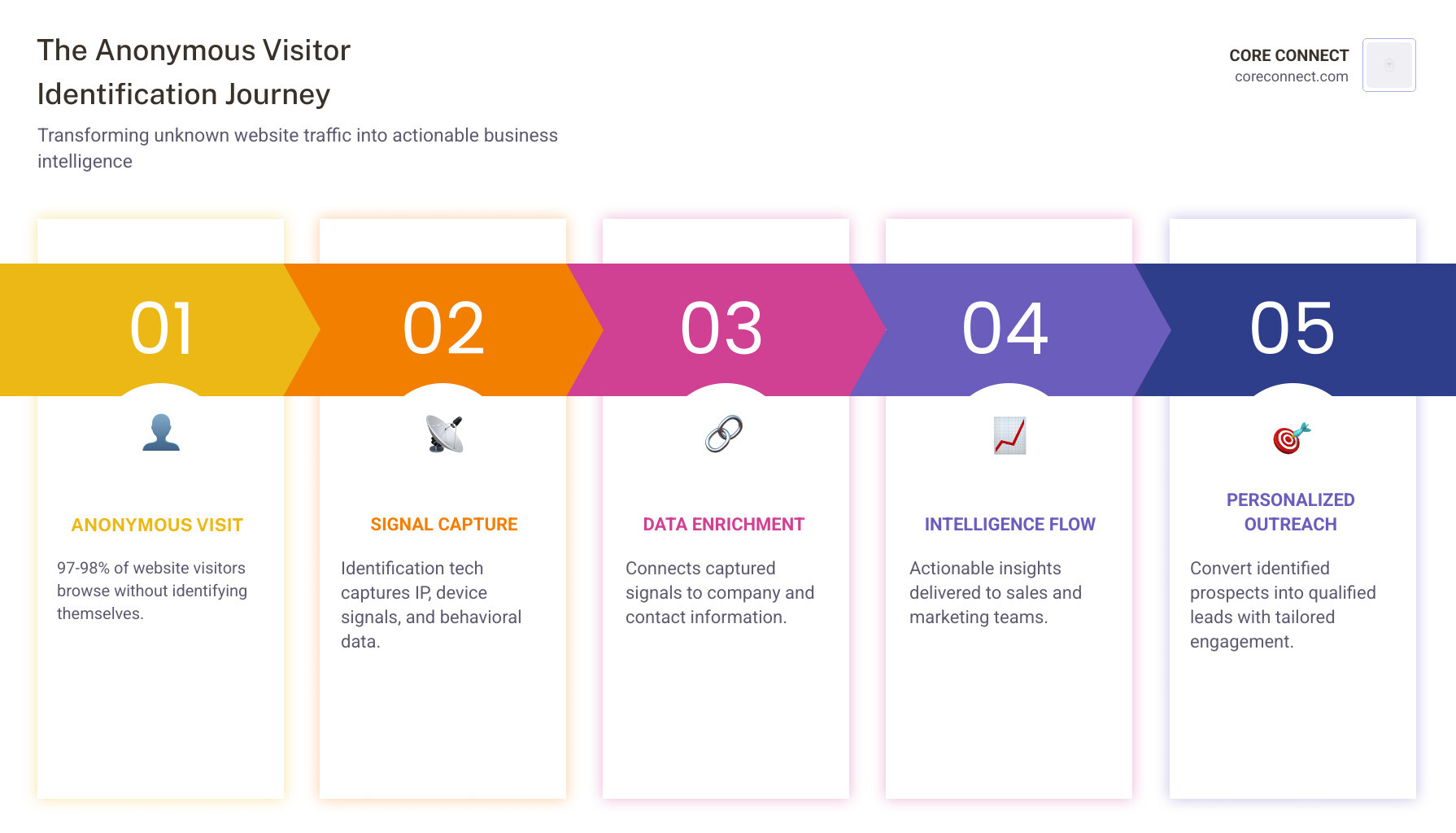
Here’s a frustrating reality: 97–98% of your website visitors leave without ever identifying themselves. They browse your pricing page, read your case studies, compare your solutions to competitors, and disappear—leaving you with nothing but anonymous pageview data in Google Analytics.
For businesses already investing in digital ads and SEO, this represents a massive blind spot. You’re paying to drive traffic, but you can’t see who that traffic actually is. A Fortune 500 company could be researching your product for weeks, and unless they fill out a form, you’d never know they exist.
The gap between website traffic and identified leads creates serious problems. Marketing can’t prove which campaigns attract qualified buyers. Sales doesn’t know which accounts are actively researching solutions. And the website—your most important digital asset—becomes a black box instead of an intelligence engine.
Anonymous website visitor identification solves this by revealing the companies and sometimes individuals behind your traffic. It shows you which accounts are visiting, what they’re interested in, and when they’re showing buying intent—all without requiring a form fill.
I’m Stephen Sovenyhazy, founder of CORE CONNECT, and over the past 20 years I’ve helped businesses transform their websites from marketing expenses into revenue-generating platforms. Understanding what is anonymous website visitor identification is and how to implement it effectively has helped my clients increase organic lead generation by 100–300% while dramatically improving lead quality and sales conversion rates.
What is Anonymous Website Visitor Identification?
At its core, what is anonymous website visitor identification? It is the technical “detective work” that connects the dots between a digital footprint and a real-world entity. When a visitor lands on your site, they arrive with a set of non-personal signals: an IP address, a browser type, a device model, and a specific pattern of behavior. Identification technology takes these breadcrumbs and runs them through a massive database—often called an identity graph—to resolve that data into a name.
In a B2B context, this usually means “IP-to-company resolution.” We can see that a visitor from a specific IP address belongs to a law firm in downtown Charleston or a manufacturing plant in the Lowcountry. In B2C, it often involves cross-referencing hashed email data or device fingerprints to understand who the individual might be, even if they haven’t logged in.
The goal isn’t just to see a name; it’s to understand intent. If a visitor from a major regional hospital spends ten minutes on your “Managed IT Services” page and then downloads a whitepaper on cybersecurity, they aren’t just “traffic”—they are a high-intent prospect.
Research shows that 97–98% of website visitors never identify themselves. They don’t fill out a form, share an email address, or leave a name. They browse, compare, hesitate, and leave. Without identification tools, they remain ghosts in your machine.
The Difference Between Anonymous and Unique Website Visitors
It’s easy to get these terms mixed up, but they serve very different roles in your analytics.
- Unique Visitors: These are individuals who have visited your site at least once during a specific period. If a business owner in Mount Pleasant visits your site on Monday and again on Wednesday, standard tools like Google Analytics count them as one “unique visitor.” They are typically identified by a cookie placed in their browser. Unique visitors help you understand the size of your audience, but they don’t necessarily tell you who that audience is.
- Anonymous Visitors: These are the people who have not yet “raised their hand.” They haven’t filled out a contact form, signed up for a newsletter, or logged into a customer portal. They are “anonymous” because their personal identity remains hidden, even though you might be tracking their session.
The “mystery” we are trying to solve is turning these anonymous unique visitors into identified accounts or people.
Why Understanding Behavior and Intent is Crucial
If you only look at traffic volume, you’re missing the forest for the trees. Understanding behavior allows us to differentiate between a student doing a research project and a decision-maker looking to buy.
When we identify an anonymous visitor, we aren’t just looking for their name; we are looking for buying signals. Did they visit the pricing page? Did they look at your “About Us” page to check your local Charleston roots? Did they return three times in 24 hours?
This data is vital because 71% of consumers expect personalized interactions from businesses. If we know a visitor is interested in a specific service, we can tailor the website experience or our sales follow-up to match that interest perfectly. It’s the difference between a cold call and a warm, helpful conversation.
How to Identify Anonymous Website Visitors: Core Methods
To pull back the curtain on your traffic, we use a combination of several technical methods. No single method is 100% perfect, but when layered together, they provide a remarkably clear picture.
- IP Intelligence & Reverse IP Lookup: Every device on the internet has an IP address. We use databases to match these addresses to known organizations. If someone from a specific office building in Mount Pleasant visits your site, we can often identify the company name associated with that network.
- First-Party Cookies: These are small text files placed on a visitor’s browser by your website. They are essential for recognizing returning visitors and understanding their journey over time. Unlike third-party cookies (which are being phased out), first-party cookies are generally considered safer and more privacy-compliant.
- Behavioral Analytics: We look at “digital body language.” How deep did they scroll? Which buttons did they hover over? This helps us score the lead’s intent level.
| Method | How it Works | Best For… |
|---|---|---|
| IP Tracking | Matches IP address to a company database. | Identifying B2B accounts and office locations. |
| Browser Fingerprinting | Collects unique device/browser signals. | Identifying returning visitors even without cookies. |
| Cookie Tracking | Places a small file in the user’s browser. | Session continuity and personalizing repeat visits. |
| Form Capture | Links previous anonymous behavior to a form fill. | Retroactively seeing a lead’s entire history. |
Advanced Techniques for Identifying Anonymous Website Visitors
As the web becomes more privacy-focused, “old school” tracking is becoming less effective. This is where advanced techniques come into play.
- Browser and Device Fingerprinting: This creates a unique identifier based on a visitor’s specific setup—their operating system, screen resolution, installed fonts, and even battery level. It allows us to recognize a returning visitor even if they clear their cookies or use incognito mode. Studies show browser fingerprinting can identify returning visitors with up to 90% accuracy.
- AI-Powered Tracking: At CORE CONNECT, we use AI to study behavior and predict intent. Our proprietary technology in the Reveal Marketing Hub doesn’t just look at what a visitor did; it predicts what they are likely to do next based on billions of data points.
- Server-Side Tracking: Instead of relying on the visitor’s browser to send data (which can be blocked by ad blockers), we capture interactions directly from the server. This provides a much more reliable and accurate view of visitor behavior.
Why Standard Security Tools Are Not Enough for Visitor Identification
Many businesses assume their Web Application Firewall (WAF) or security suite handles visitor identification. Platforms like AWS WAF, Imperva WAF, Cloudflare, and open-appsec are fantastic for blocking malicious bots and DDoS attacks.
However, these tools do not provide the mechanism for actually identifying anonymous visitors for marketing purposes. They are built to keep “bad” traffic out, not to help you understand “good” traffic. Relying solely on a WAF for visitor intelligence is like having a security guard at the door who can spot a burglar but can’t tell you which of your VIP clients just walked in. You need specialized visitor intelligence to bridge that gap.
The Business Impact of Unmasking Your Traffic

When we stop guessing and start knowing who is on our site, everything changes. For our clients in South Carolina, this is often the “aha!” moment where marketing spend finally makes sense.
- Lead Prioritization: Instead of chasing every lead, your sales team can focus on the “big fish” that have been lurking on your site for weeks.
- Sales and Marketing Alignment: We can finally prove that the SEO campaign or the LinkedIn ad actually brought a target account to the site.
- Personalization: When we know a visitor’s industry or company size, we can serve them content that actually matters to them.
The impact is measurable. According to McKinsey, only 8% of B2B organizations deliver highly personalized marketing, but within that group, three-fourths report growing market share.
Improving Lead Generation and Marketing ROI
Most businesses are “fishing with holes in their net.” They spend money to drive 1,000 visitors, 20 people fill out a form, and they ignore the other 980.
Even with sophisticated tools, most businesses can typically recognize only about 30% of their traffic. That means nearly 70% of visitors remain anonymous. However, identifying that 30% can double or triple your actionable lead pool overnight.
By using the Reveal Marketing Hub, we help businesses in the Lowcountry capture that “hidden” 30% and turn them into a pipeline. Imagine knowing exactly which local businesses are researching your services right now. That’s not just data—that’s a competitive advantage.
Navigating Privacy, Ethics, and Compliance
We cannot talk about what is anonymous website visitor identification without talking about privacy. As a Charleston-based company, we take this seriously. There is a fine line between “helpful personalization” and “creepy surveillance.”
To stay on the right side of the law and maintain user trust, we adhere to several key frameworks:
- GDPR: While this is a European regulation, it sets the global gold standard. It requires transparency and, in many cases, explicit consent for tracking.
- CCPA & CPRA: These California laws give users the right to know what data is being collected and the right to opt-out. Even if you aren’t in California, following these practices is a business best practice.
Ethical Tracking Checklist:
- Transparency: Always have a clear, accessible privacy policy.
- Anonymization: We focus on company-level data whenever possible to protect individual privacy.
- Consent: Use clear cookie banners that allow users to choose their level of tracking.
- Security: Ensure all visitor data is encrypted and stored securely.
Frequently Asked Questions about Visitor Identification
Is identifying anonymous website visitors legal?
Yes, absolutely—provided it is done correctly. Identifying visitors is legal when you avoid collecting Personally Identifiable Information (PII) without consent and follow regional privacy laws. In the U.S., tracking company-level data (like knowing a visitor came from a specific corporation) is generally wide open. In the EU, you need to be more careful with consent mechanisms. We always recommend consulting with a legal expert to ensure your specific implementation meets all local and federal guidelines.
How accurate is anonymous visitor identification?
Accuracy varies by method. IP-based identification for B2B is usually 70-80% accurate for office-based workers. Browser fingerprinting can reach up to 90% accuracy for recognizing returning devices. Overall, most businesses can expect to recognize only about 30% of their traffic at a high level of detail. While it’s not 100%, it’s infinitely better than the 0% visibility most businesses currently have!
Can small businesses benefit from visitor tracking?
We hear this a lot in Mount Pleasant and Charleston: “Is this only for the big guys?” The answer is no. In fact, small businesses often benefit more because their marketing budgets are tighter. If you only have $1,000 to spend on ads, you need to know exactly which of those clicks are turning into real opportunities. Identification technology allows small teams to “punch above their weight class” by being the first to reach out to a high-value prospect.
Conclusion: Mastering Your Website Intelligence
The days of your website being a “mystery” are over. By understanding what is anonymous website visitor identification, you can stop hoping for form fills and start acting on real-time intelligence.
At CORE CONNECT, we’ve built our growth platform around this very concept. Our Reveal Marketing Hub unifies your CRM, email, and automation with advanced visitor-level data. Whether you’re a local service provider in the Lowcountry or a regional B2B firm, we give you the “X-ray vision” needed to see who is visiting your site and what they want.
Don’t let 98% of your opportunities walk out the door. It’s time to turn those anonymous clicks into real conversations and sustainable revenue.
Are you ready to stop guessing? Mastering website visitor identification is the first step toward scaling your business with clarity and control. Let’s get to work.