
SEO and website design: Smart Boost 2026
Why SEO and Website Design Work Together
SEO and website design are not separate projects—they’re two halves of the same system. SEO helps people find your site. Design helps them stay, trust you, and take action. When they work together from the start, you get better rankings, more engaged visitors, and higher conversions.
Here’s what improves when SEO and website design are aligned:
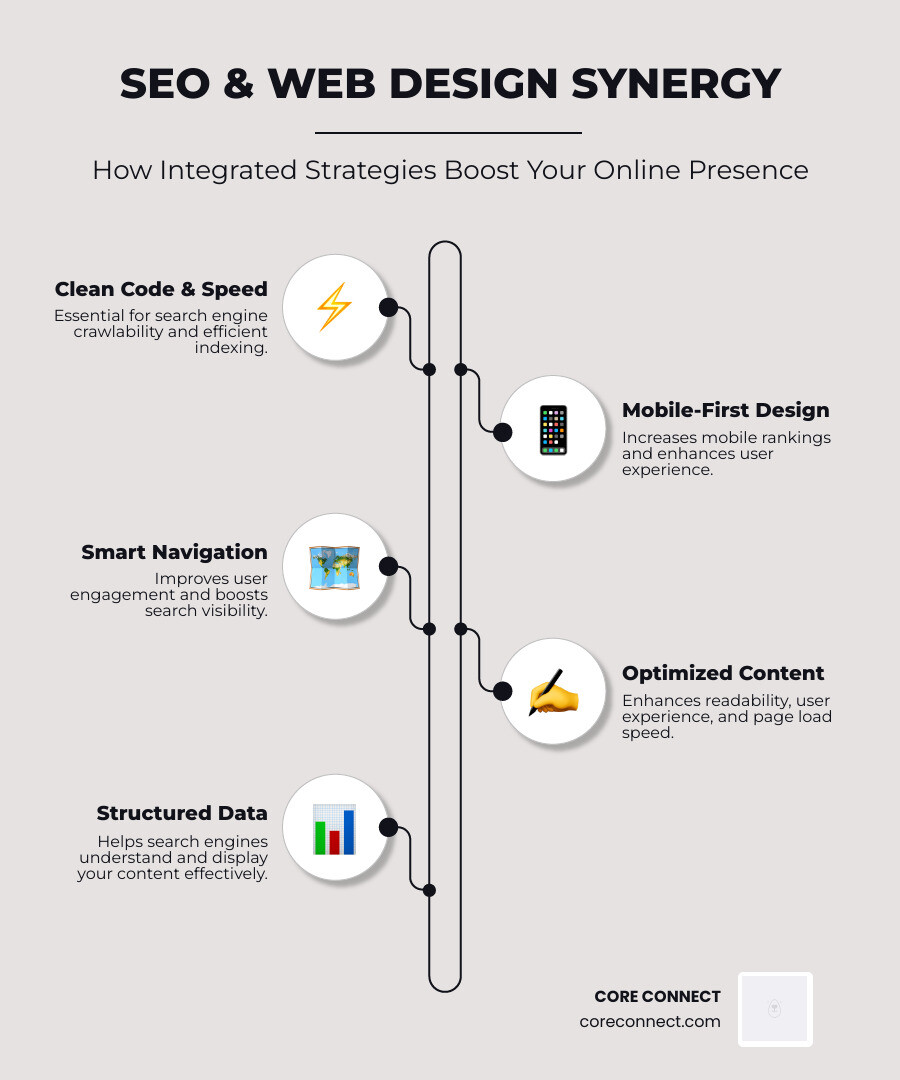
- Search rankings – Clean code, fast loading, and mobile-friendly layouts help Google index and rank your pages
- User engagement – Clear navigation, readable content, and intuitive structure keep visitors on your site longer
- Conversion rates – Trust signals, strategic CTAs, and streamlined user flows turn traffic into leads
- Long-term growth – A strong foundation reduces the need for constant paid ads and expensive redesigns
Most businesses treat SEO and design as separate tasks. The designer builds something beautiful. Then someone tries to “add SEO” later. This creates friction—slow sites, poor mobile experiences, content that’s hard to crawl, and layouts that don’t convert.
The truth is simpler: when you build SEO into the design process from day one, the site works better for both search engines and real people.
Over 62% of all web traffic now comes from mobile devices. Google uses mobile-first indexing. Page speed is a confirmed ranking factor. User experience signals like bounce rate and dwell time directly influence where you rank. These aren’t nice-to-haves anymore—they’re the baseline.
But here’s what matters most: your website should be an asset that compounds value over time, not a cost center that requires constant ad spend to stay visible. That shift happens when SEO and design are treated as one strategy, not two competing priorities.
I’m Stephen Sovenyhazy, and I’ve spent over 20 years building websites and SEO strategies that turn organic traffic into measurable revenue for businesses across healthcare, marine, fitness, and professional services. At CORE CONNECT, we’ve helped clients increase organic traffic by 100–300% within 6–12 months by integrating SEO and website design from the ground up, not as an afterthought.
The Fundamentals of SEO and Website Design
When we talk about the fundamentals of a high-performing website, we’re looking at a bedrock of technical stability and visual appeal. Many business owners in Charleston and Mount Pleasant ask us: “Why can’t I just make it look good and worry about the Google stuff later?”
The answer lies in how search engines work. Google’s algorithm uses 200 factors to rank a website. If your design makes it impossible for Google to “crawl” (read) or “index” (store) your pages, it doesn’t matter how pretty the colors are—no one will ever see them.
Crawlability refers to the search engine’s ability to steer through your site’s content. Indexability is whether Google actually adds those pages to its database. If your design is buried in complex, heavy JavaScript or lacks a logical hierarchy, you’re essentially locking the front door to the world’s biggest mall.
Furthermore, a well-designed site builds brand authority. When a visitor lands on a site that feels professional and intuitive, they trust the business behind it. Conversely, 94% of customers cited “bad design” as the reason they mistrusted certain websites. By prioritizing user experience (UX), you aren’t just pleasing humans; you’re following Google’s preferred standards. In fact, research shows that an ROI of 9,900% for UX improvements is possible, with every dollar invested in UX potentially bringing $100 in return.
The Relationship Between User Experience (UX) and SEO
In the modern digital landscape, UX is SEO. Google has moved away from just looking at keywords; it now looks at how people behave on your site. We call these “user signals.”
If a user clicks your link in the search results and immediately hits the “back” button because the site is confusing or ugly, that’s a “bounce.” High bounce rates tell Google your page wasn’t a good result for that search. On the other hand, “dwell time”—the amount of time a user spends on your page—signals that your content is valuable.
Google also measures “visual stability.” Have you ever tried to click a button on a mobile site, only for the page to jump at the last second, causing you to click an ad instead? That’s poor visual stability (measured as Cumulative Layout Shift), and Google penalizes it.
| UX Metric | SEO Impact | Why It Matters |
|---|---|---|
| Dwell Time | High | Longer stays signal relevance and quality to Google. |
| Bounce Rate | Medium/High | Rapid exits suggest the page didn’t meet user intent. |
| Visual Stability (CLS) | Medium | Part of Core Web Vitals; affects ranking and frustration. |
| Mobile Friendliness | Very High | Essential for mobile-first indexing and user retention. |
Benefits of an Optimized Web Design for Conversion
The ultimate goal of combining SEO and website design isn’t just to get “hits”—it’s to get customers. When your site is optimized, you attract “high-intent traffic.” These are people specifically looking for what you offer in the Lowcountry.
A conversion-focused design uses trust signals—like reviews, professional certifications, and secure HTTPS badges—to lower a visitor’s guard. Since 94% of customers judge businesses by website design, your visual presentation is your first and most important “sales pitch.”
Good design also simplifies the path to purchase. Whether it’s a “Book Now” button that stands out or a contact form that actually works on a smartphone, an optimized design removes the friction that kills lead generation. At CORE CONNECT, we use Reveal Marketing Hub to see exactly where these visitors are coming from and what they do, allowing us to tweak the design based on real human behavior, not just guesswork.
Key Elements for Search Visibility and Performance
To win at SEO and website design, we have to look under the hood. Information architecture is the fancy term for how your site is organized. Think of it like a library: if the books aren’t categorized correctly, you’ll never find what you need.
We recommend a “shallow” architecture, meaning any page on your site should be accessible within three clicks from the homepage. This makes it easy for both users and search engine bots to find everything.
Technical elements are the heavy lifters here. Metadata (the titles and descriptions that appear in search results) and sitemaps (a roadmap for Google) are non-negotiable. Interestingly, 36% of SEO experts prioritize technical SEO as the most important element because, without it, your content is invisible.
Integrating SEO and Website Design for Mobile Users
We live in a mobile-first world. As of 2023, there were 6.47 billion active mobile internet users. In fact, over 60% of all web traffic is now generated from mobile devices. If your website looks great on a 27-inch iMac but is a nightmare to steer on an iPhone, you are losing more than half of your potential business.
Google now uses “mobile-first indexing,” which means it looks at the mobile version of your site first to determine your ranking.
Essential Mobile Design Tips:
- Responsive Design: Your site should automatically “respond” and resize to fit any screen.
- Touch Navigation: Buttons should be large enough to be tapped with a thumb (no “fat-finger” errors!).
- Readable Text: No one wants to pinch and zoom to read your blog posts. Use a minimum font size of 16px.
Best Practices for SEO and Website Design Speed
Speed is a killer—literally. Nearly 70% of consumers admit that page speed impacts their willingness to buy. If your site takes longer than three seconds to load, 40% of your visitors will leave before they even see your logo.
Google uses “Core Web Vitals” to measure speed and performance. These include:
- Largest Contentful Paint (LCP): How fast the main content loads.
- Interaction to Next Paint (INP): How quickly the site responds when you click something.
- Cumulative Layout Shift (CLS): How much the page jumps around while loading.
You can check your own site’s performance using Google’s PageSpeed Insights. According to a study on page speed and conversions, even a one-second delay can result in a 7% reduction in conversions. To keep things fast, we always use image compression and browser caching to ensure your South Carolina business doesn’t lose customers to a spinning loading icon.
How to Create a Website with an SEO-First Approach
Creating a website with an SEO-first approach means you don’t start with the “pretty pictures.” You start with the data. We begin with keyword research to understand exactly what your customers in Charleston and Mount Pleasant are searching for. Are they looking for “Charleston boat repair” or “marine engine service Lowcountry”?
Understanding “search intent” is vital. If someone searches for “how to fix a leaky faucet,” they want information (a blog post). If they search for “emergency plumber Charleston,” they want to hire someone (a landing page). Your design should reflect these different needs.
We then build a content hierarchy. Your most important services get their own pages, and related blog posts link back to those service pages. This “hub and spoke” model is a powerful way to build authority. For those looking for professional help, you can find more info about website design services on our dedicated page.
Essential Steps for Technical Implementation
Once the plan is in place, we move to the technical build. This is where many DIY websites fail.
- URL Structure: Keep it simple and descriptive. Use coreconnect.com/charleston-seo-services instead of coreconnect.com/p=123.
- Internal Linking: Link your pages together naturally. This helps Google find new pages and distributes “ranking power” throughout your site.
- Schema Markup: This is a bit of code that tells Google exactly what your content is—an event, a product, or a local business. It’s how you get those “stars” and “reviews” to show up in search results.
- Sitemaps: You must create an XML sitemap. Follow XML sitemap best practices to ensure it’s formatted correctly.
- Search Console: Once your site is live, submit your sitemap and URLs directly to Google Search Console to tell Google, “Hey, I’m here! Come index me!”
Optimizing Multimedia and Content Readability
Images and videos are essential for engagement, but they are the primary cause of slow websites. We use the WebP format, which offers up to 34% smaller image sizes with WebP compared to traditional JPEGs, without losing quality.
Don’t forget “Alt Text.” This is a text description of your image. It helps visually impaired users understand your site via screen readers, and it tells Google what the image is about—which can help you rank in Google Image search.
Readability is also a design choice. Use plenty of white space, short paragraphs, and bullet points. When choosing typography, ensure you use fonts that are readable and accessible. If your text is hard to read, people won’t read it—it’s that simple.
Measuring Performance and Avoiding Common Mistakes
The biggest mistake we see in SEO and website design is “keyword stuffing.” This is the old-school practice of repeating your keyword 50 times on a page. Google is smarter than that now; it will actually penalize you for making your content unreadable.
Other common pitfalls include:
- Broken Links: Clicking a link that leads to a “404 Not Found” error is a terrible user experience.
- Thin Content: Pages with only a few sentences don’t provide enough value for Google to rank them.
- Uncompressed Files: Massive 5MB photos that take forever to load on a mobile data connection.
Using Website Analytics to Improve Design
At CORE CONNECT, we don’t believe in “set it and forget it.” We use analytics to see how the design is actually performing.
- Heatmaps: These show us where people are clicking and how far they are scrolling. If no one is clicking your “Buy Now” button, maybe it’s the wrong color or in the wrong place.
- Conversion Tracking: We track exactly which pages lead to phone calls or form submissions.
- Log File Analysis: This allows us to see exactly how search engine bots are interacting with your site.
By monitoring real user metrics, we can make data-driven decisions to improve your design and SEO over time.
Common Pitfalls in Combined Strategies
One of the most annoying design trends is the “intrusive interstitial”—better known as the giant pop-up that covers the whole screen the second you land on a site. Google actually has Google’s mobile interstitial guidelines that can penalize sites for using these, especially on mobile.
Security is another major factor. If your site isn’t using HTTPS (the little padlock in the browser bar), Google will mark your site as “Not Secure,” which scares away visitors and hurts your rankings. Finally, if you ever change a page’s URL, you must use a 301 redirect. Missing redirects lead to broken links and lost ranking power.
Frequently Asked Questions about SEO and Web Design
What is the difference between web design and SEO?
Web design focuses on the visual aesthetics and user experience of a site—how it looks and feels. SEO focuses on making that site visible and understandable to search engines. While they have different goals, they are two sides of the same coin. A beautiful site that no one can find is a failure, just as a top-ranking site that no one wants to use is a failure.
How long does it take to see results from SEO web design?
SEO is a marathon, not a sprint. While some technical design changes (like improving site speed) can show results in a few weeks, it typically takes 3 to 6 months to see significant movement in organic rankings. However, the results are long-lasting and provide a much higher ROI than paid advertising over time.
Can a bad website design hurt my search engine rankings?
Absolutely. If your design results in slow load times, a high bounce rate, poor mobile experience, or unreadable content, Google will notice. These poor “user signals” tell Google that your site isn’t a high-quality result, and your rankings will drop accordingly.
Conclusion
In a competitive market like Charleston, Mount Pleasant, and the Lowcountry, you can’t afford to treat your website as a static digital brochure. It needs to be a high-performance growth engine. By integrating SEO and website design, we ensure your business is not only found but trusted by your ideal customers.
At CORE CONNECT, we provide the clarity and control you need to scale. Our Reveal Marketing Hub gives you an unfair advantage by exposing exactly who is visiting your site and what they’re doing. Whether you want us to handle everything for you or you want the professional-grade tools to do it yourself, we’re here to help you turn anonymous traffic into real revenue.
Ready to stop guessing and start growing? Check out more info about search engine optimization services and let’s build something that works as hard as you do.