

To rank in Google’s AI Overviews in 2026, you need two things working together: a page that already earns a place on page one, and content written so an AI can lift a clear, verifiable answer straight out of it. That is the short version of what we found after studying more than 190 million keywords, 165 million AI-generated answers from Google and ChatGPT, and over a billion backlinks for our new report, Beyond the Blue Links: The State of Search & AI Visibility 2026.
Get the full 23-page report free →
This guide pulls out the findings that matter most for a business owner, and turns them into a ranking plan you can act on.
How Often Do AI Overviews Appear in Google Now?
AI Overviews appeared on 61.43% of the Google results we tracked in August 2026, up from 5.93% two years earlier. That is a tenfold increase. Over the same period, featured snippets, the old “answer box,” collapsed from 8.96% to 0.44%, and discussion boxes fell from 21.13% to 7.42%. Videos doubled to roughly one in five results. The local map pack grew, from 19.98% to 25.99%.
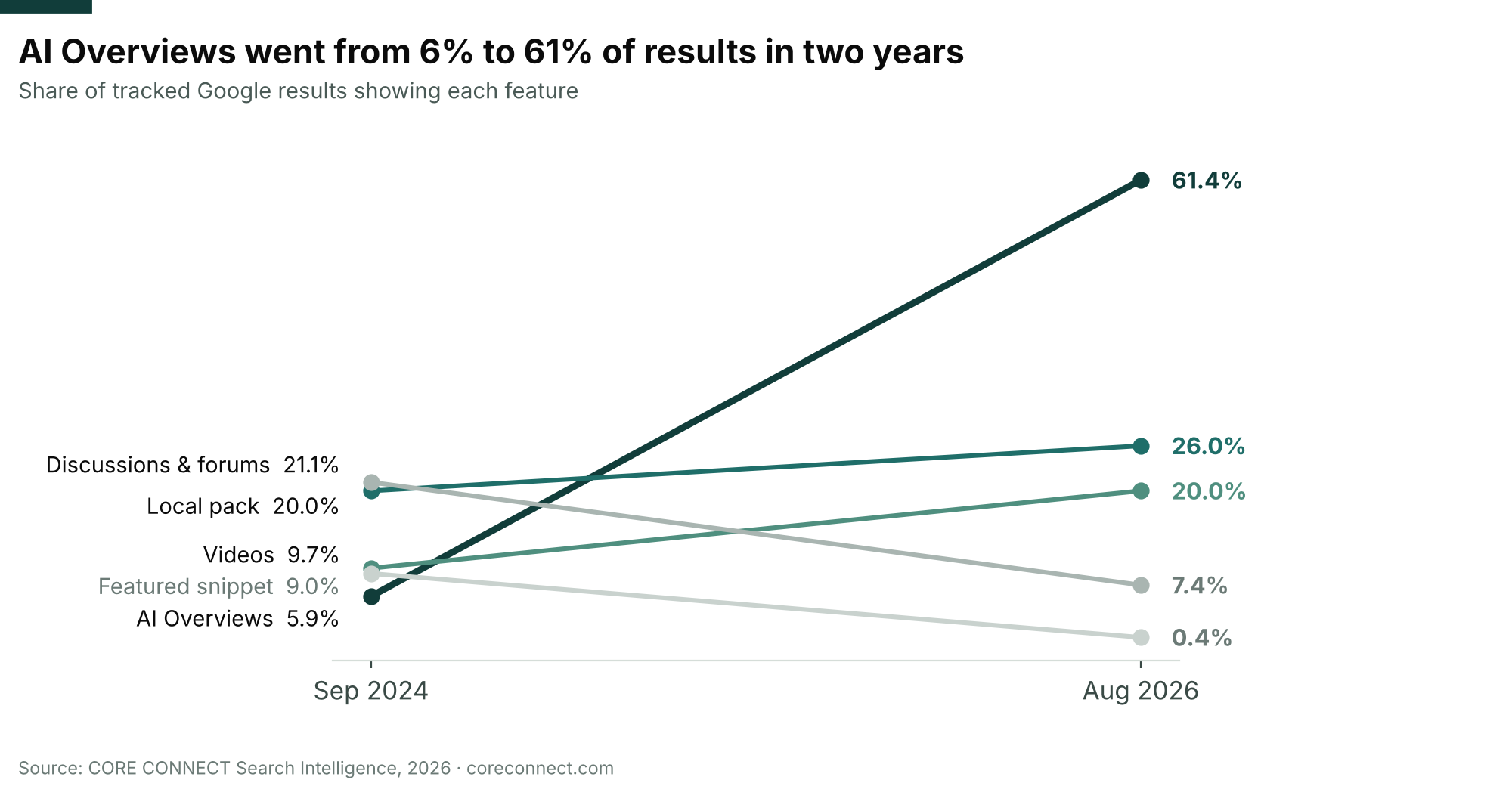
In plain terms, the AI answer is now the first thing most searchers see. For local businesses there is good news hiding in the same chart: the map pack is one of the only features that grew.
What Happens to Clicks When an AI Overview Shows Up?
When an AI Overview appears, its cited sources capture an estimated 42–45% of clicks, and the #1 organic result drops from 33–38% of clicks to 21–24%. That pattern holds across informational, navigational, commercial and transactional searches. Positions two through ten lose roughly 36–42% of their combined share as well.
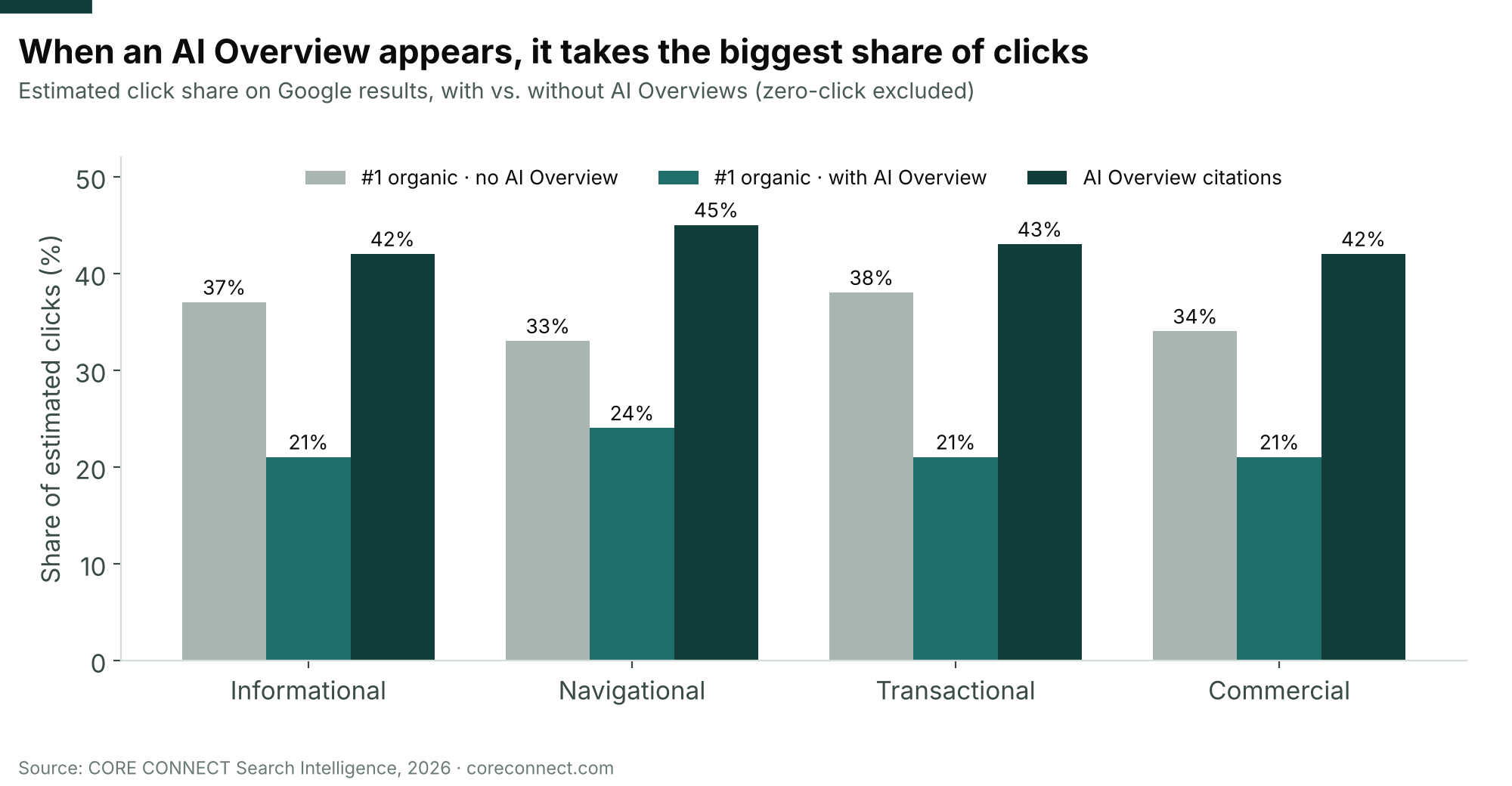
This is the single most important idea in the report. Being cited inside the AI answer is now worth more clicks than ranking first underneath it.
Which Searches Trigger AI Overviews Most?
Informational searches trigger AI Overviews most often, 70.44% of the time in Q3 2026. The fastest growth came from commercial searches, the “best,” “compare” and “reviews” queries buyers run before choosing, which nearly doubled from 26.30% to 51.35% in nine months.
Three common assumptions did not hold up:
- Smaller keywords are not safer. Keywords with 201–300 monthly searches triggered AI Overviews 58.59% of the time, more than keywords with 601+ searches (48.62%).
- Easy keywords are not safer. Mid-difficulty keywords triggered AI Overviews about 65% of the time; the hardest keywords were lowest at 53.76%.
- Expensive keywords are not safer. Keywords costing $5+ per click triggered AI Overviews 49.55% of the time, almost the same as the cheapest keywords (50.54%).
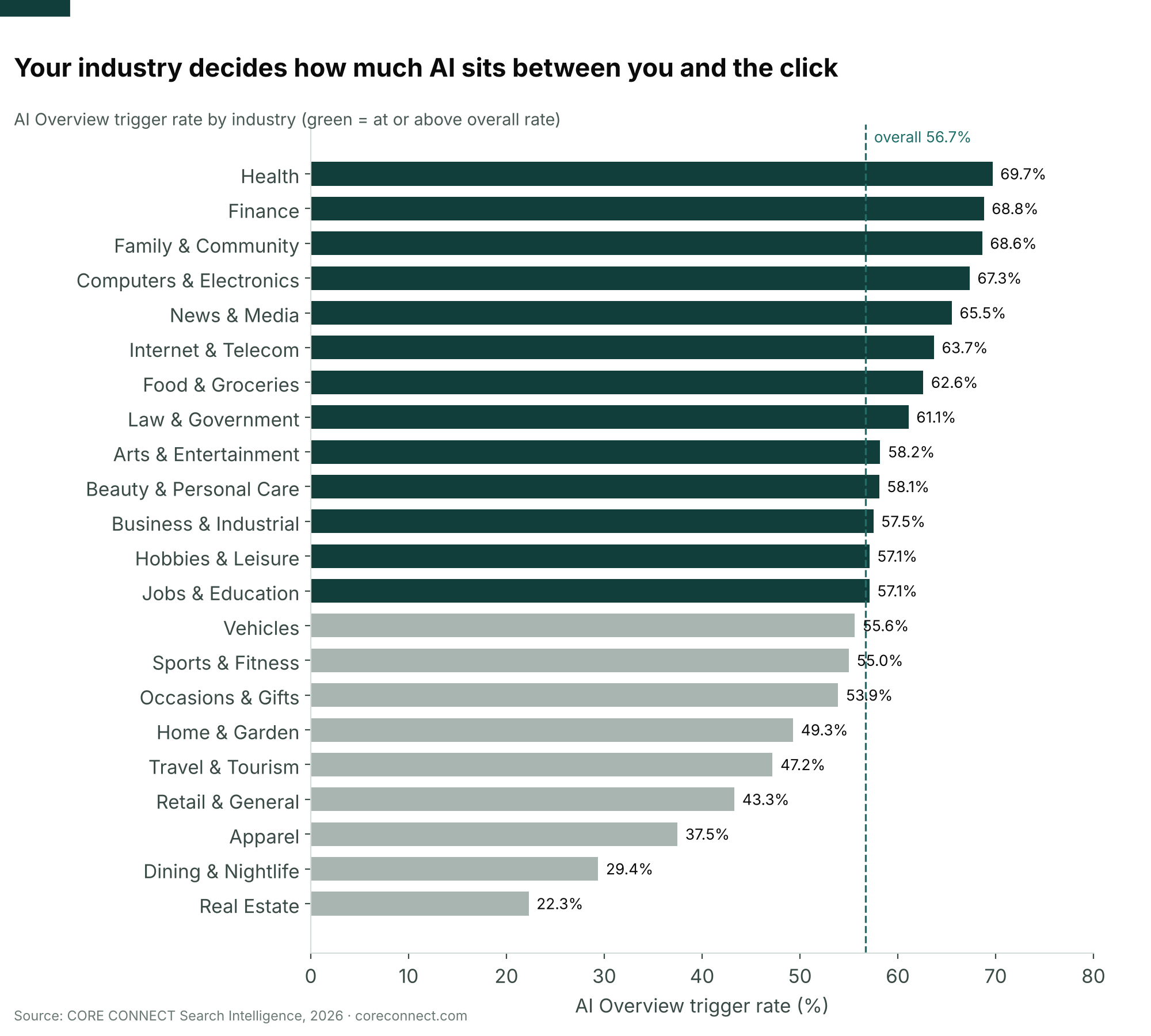
Industry made the biggest difference. Health (69.68%), finance (68.80%) and law and government (61.1%) see AI answers far more often than real estate (22.27%) or dining (29.37%).
How to Rank in AI Overviews: The Six-Step Plan
We studied the live Google results for the questions owners are asking right now, including “how to rank in AI Overviews” itself. Every one opens with an AI Overview, and the pages being cited share the same traits. Here is the plan we use with clients.
1. Earn page one first
AI Overviews overwhelmingly cite pages that already rank in the top results. Technical health, fast pages, clean indexing and real topical depth come first. Build topic clusters, a pillar page supported by focused articles, so you rank for the follow-up questions Google breaks a search into behind the scenes.
2. Lead with the answer
Open every section with a direct two-to-three sentence answer, then expand. Use headings that match the questions people actually type, short lists, comparison tables and an FAQ block. If an AI can quote your first paragraph as a complete answer, you have done this right.
3. Add something an AI can’t find anywhere else
Generic content gets summarized; original content gets cited. Add your own data, local examples, price ranges, before-and-after results and first-hand experience. That “information gain” is the reason to cite you instead of the next page.
4. Make your business easy to verify
Keep your name, address, phone, hours and services identical on your site, your Google Business Profile and every directory. Use structured data so search and AI systems know exactly who you are. Keep your Google Business Profile active with weekly posts, photos and review replies.
5. Build authority where AI looks
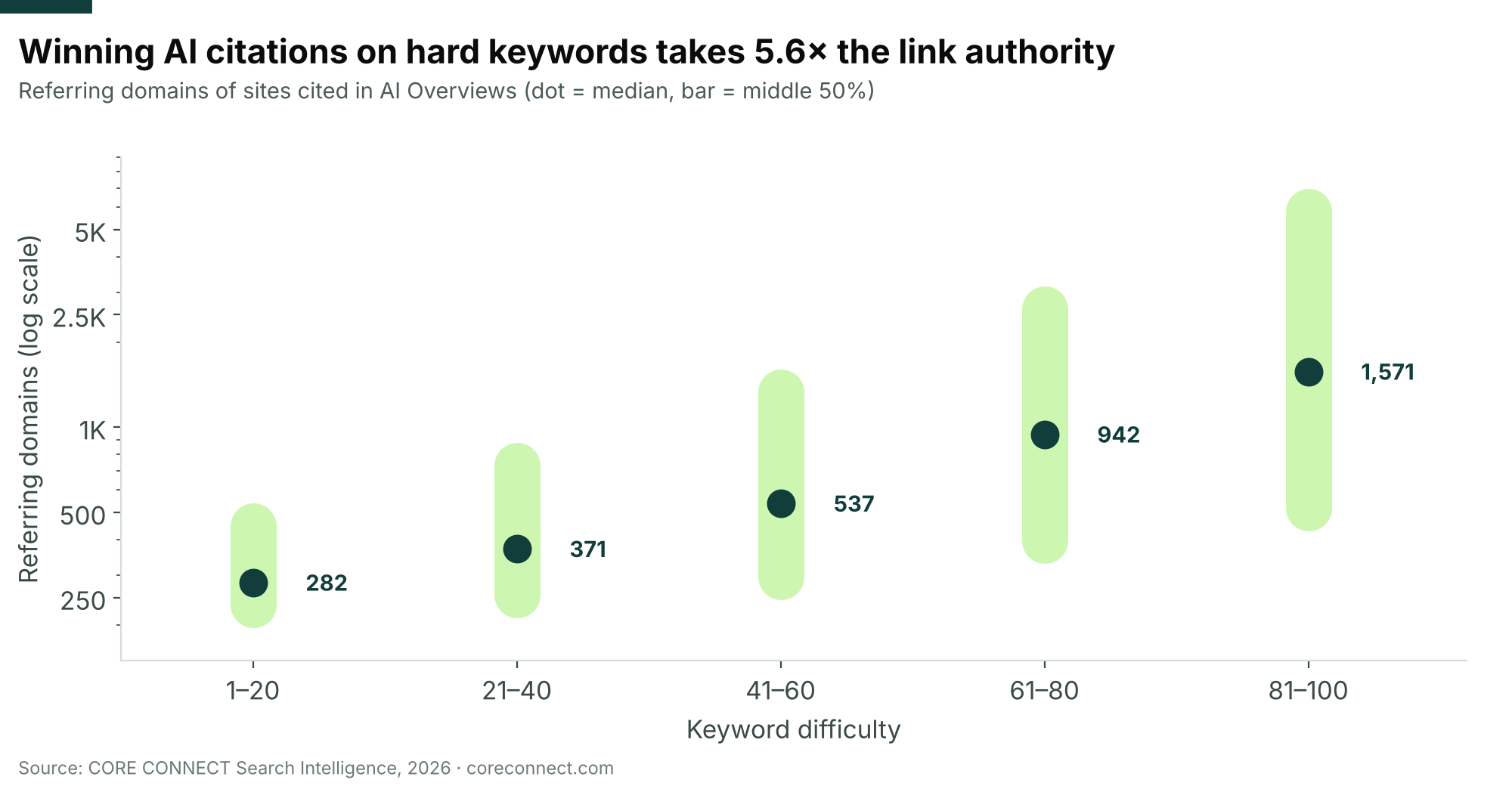
Domains ranking #1 had a median of 111 referring domains, 31% more than positions four through ten. Sites cited in AI Overviews for the hardest keywords had 5.6 times more referring domains than those cited for the easiest. Earn links and mentions from relevant local and industry sources, publish short useful videos on YouTube (the most-cited domain in Google’s AI answers), and take part honestly in the Reddit threads that rank for your services.
6. Convert the clicks that remain
The visitor who clicks past an AI answer is further along and closer to buying. Give them proof, clear next steps, and a fast way to call, book or buy. Watch how real visitors scroll and click, and fix the pages that leak.
What This Means for Charleston Businesses
For a local service business, the 2026 search results page is three things stacked on top of each other: an AI answer, a map pack and the classic links. Each rewards different work. The AI answer rewards clear, verifiable content and authority. The map pack rewards a complete, active Google Business Profile and reviews. The links reward the fundamentals. A plan that only chases rankings now covers one third of the page.
That is why our AI SEO and local SEO work is measured across every surface, not just a rank tracker. If you want to know specifically how to get your business named by assistants like ChatGPT and Gemini, start with our guide on how to get your business mentioned and named in AI assistants.
Get the Full Report
The full report covers query length trends, click-through rate changes by device, AI Overview exposure by industry, the most-cited websites in Google and ChatGPT, Reddit’s role in search, and the backlink patterns behind AI citations, with 14 charts and our complete playbook.
Tell us where to send it and the download opens right away:
Want to see where your own business shows up, and where it doesn’t? Request a free website and AI visibility review.
Frequently Asked Questions
How do I rank in Google AI Overviews?
Rank on page one for the topic first, then structure your page so the answer is easy to quote: a direct answer at the top of each section, question-style headings, lists, tables and an FAQ. Add original information, keep your business details consistent everywhere, and build authority through relevant links and mentions. AI Overviews mostly cite pages that already rank well.
How many Google searches show an AI Overview?
In our tracking, AI Overviews appeared on 61.43% of Google results in August 2026, up from 5.93% in September 2024. Informational searches trigger them most often (70.44% in Q3 2026), and commercial searches reached 51.35%.
Do AI Overviews reduce website traffic?
They redistribute it. When an AI Overview appears, its cited sources capture an estimated 42–45% of clicks and the #1 organic result falls to 21–24% of clicks, from 33–38% without one. Being cited in the AI answer is now worth more than ranking just below it.
Do backlinks still matter for AI search?
Yes. Referring domains showed a moderate positive correlation with citations in both Google AI Overviews (0.406) and ChatGPT (0.377), stronger than community links alone. Sites cited for the hardest keywords had 5.6 times more referring domains at the median. These are associations, not proof of cause, but authority clearly still travels with visibility.
Which industries see the most AI Overviews?
Health (69.68%), finance (68.80%) and family and community (68.63%) lead. Real estate (22.27%), dining and nightlife (29.37%) and apparel (37.48%) see the fewest. If you are in a high-exposure industry, being the cited source matters even more.