
In Depth Guide to Comparing CRM Platforms
Why Your Business Needs a CRM Platform to Scale
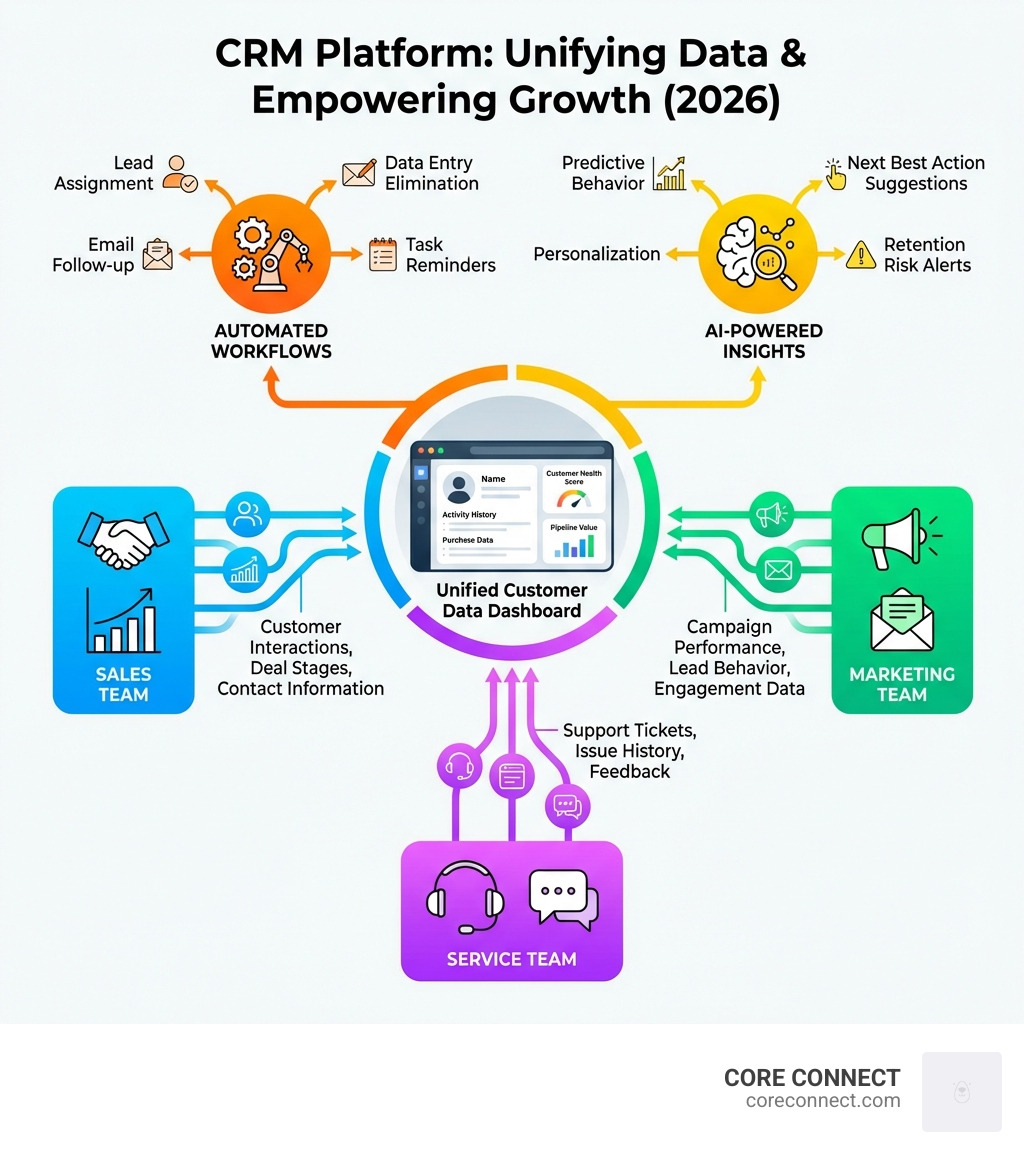
A crm platform is a system that centralizes all of your company’s customer interactions, contact information, and sales data in one place. Its primary purpose is to help businesses manage relationships more effectively, improve team collaboration, and grow revenue by turning scattered customer data into actionable insights.
Quick Answer: What a CRM Platform Does
- Unifies customer data from sales, marketing, service, and commerce teams into a single source of truth
- Automates repetitive tasks like data entry, follow-up emails, and lead assignment
- Tracks the customer journey from first contact through purchase and beyond
- Improves team productivity by making customer history visible to everyone who needs it
- Increases revenue and retention through better visibility and more personalized service
The challenge many businesses face isn’t a lack of customer data—it’s that the data lives in too many places. The average organization uses close to 1,000 different applications, but only 28% of those apps are integrated. When your sales team uses one tool, marketing uses another, and customer service operates from a third system, critical information gets lost. Customers notice this disconnect: 70% expect every representative they contact to know their purchase and issue history.
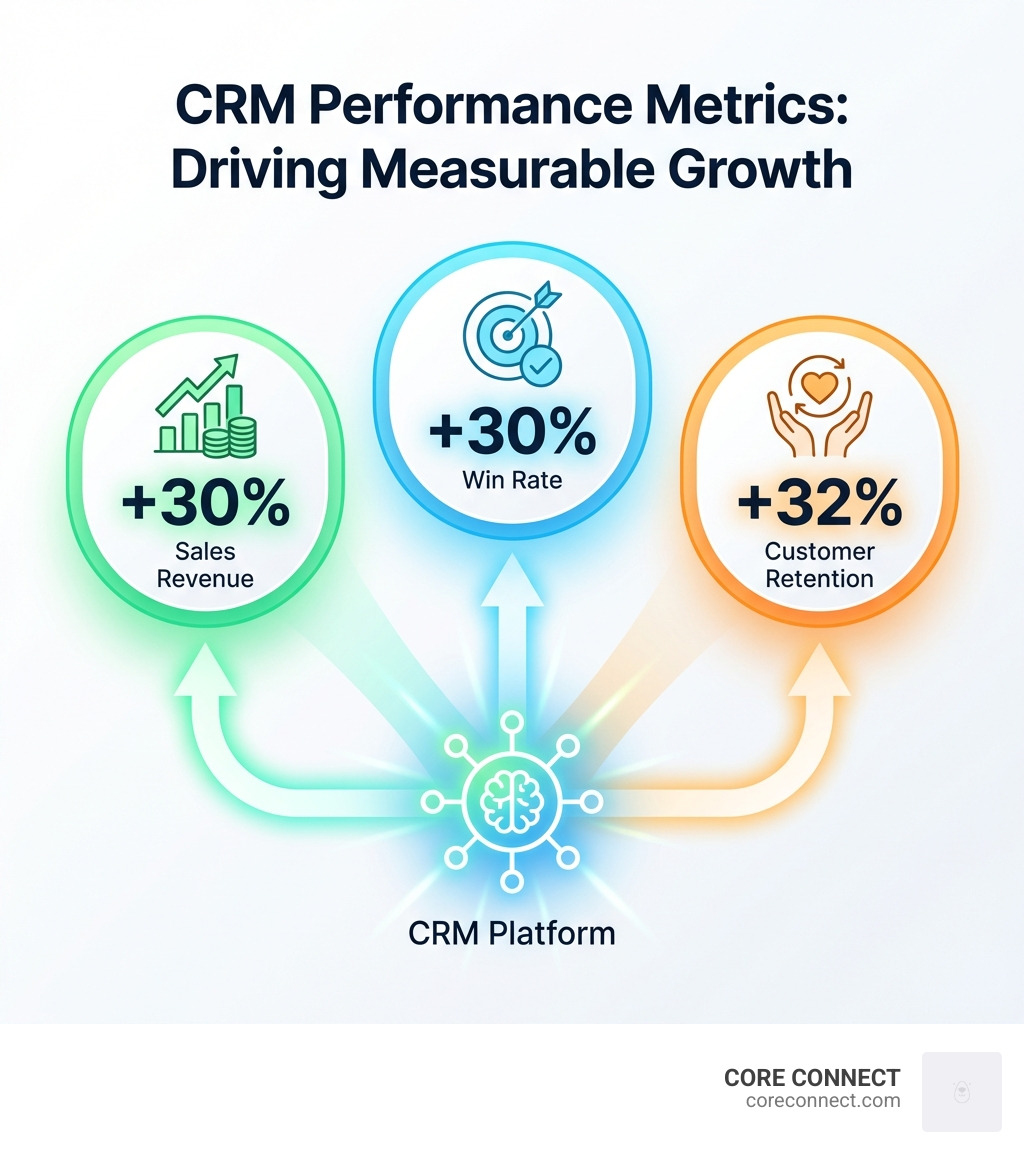
A CRM platform solves this problem by acting as a central hub. It stores contact information, interaction history, and communication preferences, then turns that raw data into a useful view of each customer’s journey. When done right, businesses see measurable results: +30% sales revenue, +32% customer retention, and +32% increase in ROI.
Modern CRM platforms go beyond basic contact management. They include automation features that handle repetitive tasks, AI tools that predict customer behavior and suggest next steps, and integrations that connect with the other apps your business already uses. Cloud-based CRM solutions have become the standard because they offer flexibility, automatic updates, and lower IT costs compared to on-premises systems.
I’m Stephen Sovenyhazy, founder of CORE CONNECT, where I’ve spent over 20 years helping businesses build digital systems they own and control—including implementing crm platform strategies that turn anonymous website traffic into qualified sales opportunities. In this guide, I’ll walk you through how CRM platforms work, what to look for when comparing options, and how to choose the right solution for your business.
The Purpose and Business Benefits of a CRM Platform
At its heart, a crm platform is designed to solve the “fragmented data” problem. Think of it as the brain of your business. Without it, your sales team might be keeping notes in a spreadsheet, your marketing team is using a separate email tool, and your customer service reps are digging through old emails to find out why a client is upset. This lack of organization doesn’t just cause headaches; it costs money.
The primary purpose of a CRM is to create a single source of truth. When every department—from sales and marketing to digital commerce and IT—works from the same up-to-date information, the entire customer journey becomes visible. We can see exactly when a lead first visited our site, which marketing strategies caught their eye, what they bought, and every conversation they’ve had with our team since.
For a broader, neutral definition of what CRM is and how it evolved, see Customer relationship management.
Data Unification and the Customer Journey
CRM software unifies silos. It brings together data from multiple points in the buyer journey to create a 360-degree view of the customer. This allows us to provide personalized experiences that foster loyalty. For example, if a customer calls in with an issue, a service agent can see their entire purchase history and past marketing offers immediately. This prevents the “I’ve already told three people this” frustration that 70% of customers dread.
Measurable ROI and Growth
The benefits aren’t just theoretical; they are backed by significant data. According to industry-wide customer success metrics, businesses implementing a robust CRM see a dramatic impact on their bottom line.
| Metric | Average Increase with CRM |
|---|---|
| Sales Revenue | +30% |
| Win Rate | +30% |
| Faster Deal Closure | +30% |
| Customer Retention | +32% |
| Marketing ROI | +32% |
| Customer Satisfaction | +32% |
By automating data entry and administrative work, a crm platform frees up your team to focus on revenue-generating activities. It preserves data integrity, ensuring that if a salesperson leaves your company, their leads and contact notes don’t walk out the door with them.
Comparing Operational, Analytical, and Collaborative Models
Not all CRM platforms are built the same. Depending on your business goals, you might lean toward one of three primary functional types. Most modern solutions offer a mix of all three, but understanding the categories helps you prioritize features.
1. Operational CRM: The “Doer”
Operational CRMs focus on streamlining the day-to-day “work” of your business. They use automation to handle repetitive tasks across three main areas:
- Marketing Automation: Managing campaigns, lead assignment, and email scheduling.
- Sales Automation: Organizing the sales pipeline, tracking leads, and automating follow-ups.
- Service Automation: Handling call center routing and customer self-service tools like chatbots.
2. Analytical CRM: The “Thinker”
If you have a mountain of data but no idea what it means, you need an Analytical CRM. These platforms excel at data visualization and customer insights. They analyze patterns in customer behavior to help you identify upselling opportunities or predict which communication channels are most effective for your specific audience. It’s about turning “what happened” into “what will happen next.”
3. Collaborative CRM: The “Connector”
Collaborative CRMs are all about synergy. They focus on interaction management and channel management, ensuring that information flows freely between sales, marketing, and service departments. By sharing knowledge across teams, you ensure the customer gets a consistent experience whether they are talking to a rep on social media, via email, or over the phone.
The Impact of AI and Automation on Functionality
We are currently living in the era of the “AI CRM.” Artificial intelligence has transformed the crm platform from a passive database into an active assistant. Modern tools don’t just store data; they act on it.
Sales and Marketing Automation
AI can now autonomously handle labor-intensive tasks. It can draft personalized sales emails, craft marketing messages, and even write product descriptions. Features like predictive analytics allow the system to score leads, telling your sales team exactly which prospects are most likely to convert so they don’t waste time on cold leads.
AI-Powered Insights and Agents
Sophisticated AI integrated into modern systems offers “next-best-action” recommendations. These systems can analyze customer sentiment in emails to alert you if a client is unhappy before they even say it. Furthermore, the rise of autonomous AI agents means businesses can now offer 24/7 customer service. These agents can resolve issues, provide product recommendations, and engage prospects without human intervention, significantly increasing workflow efficiency.
Choosing the Right CRM Platform for Your Business
Choosing a crm platform is a big decision. With over 140 options on the market, it’s easy to get overwhelmed. Here in the Lowcountry, we see many businesses struggle with systems that are either too complex for their needs or too limited to help them scale.
Cloud vs. On-Premises
The first major consideration is deployment.
- Cloud CRM (SaaS): This is the modern standard. It offers anytime, anywhere access (perfect for mobile teams), automatic updates, and requires much less IT investment.
- On-Premises CRM: This requires you to buy, install, and maintain the software on your own servers. It’s often more expensive and lacks access to the latest AI features.
- Hybrid: A mix of both, though these are becoming less common as the industry moves toward the cloud.
Integration and Scalability
The average company uses close to 1,000 apps, yet only 28% are integrated. Your CRM must be able to connect with other business apps like your email, calendar, accounting software, and website visitor identification tools. If it can’t talk to your other tools, you’re just creating another data silo.
Key Considerations for Your Selection
When comparing, look for a solution that balances extensibility with ease of use. For local businesses in Charleston or Mount Pleasant, we often recommend starting with a system that can grow with you. You don’t want to have to switch platforms in two years because you’ve outgrown your current one. Look for platforms that offer:
- Versatility: A system that handles sales, marketing, and service in one place.
- AI-Powered Insights: Tools that help you predict customer behavior and suggest next steps.
- Intuitive Pipelines: A visual way to track deals and leads to ensure nothing falls through the cracks.
- Automation Depth: The ability to build complex, multi-step workflows that save your team time.
Frequently Asked Questions about CRM Platforms
What is the primary purpose of a CRM platform?
The primary purpose of a crm platform is to centralize and manage all customer interactions and data in one place. It acts as a central hub that allows teams across sales, marketing, and service to access a unified view of the customer, fostering relationship growth and improving business efficiency.
How does a CRM platform improve customer retention?
A CRM improves retention by providing a full history of every customer’s purchases, issues, and preferences. This allows your team to provide proactive, personalized service. Because reps know exactly what a customer has experienced in the past, they can resolve issues faster and offer relevant suggestions, which leads to a +32% increase in retention rates on average.
What are the advantages of a cloud-based CRM platform?
Cloud-based CRMs (SaaS) offer several key advantages:
- Automatic Updates: You always have the latest features and security patches without lifting a finger.
- Remote Access: Your team can access data from anywhere via mobile devices.
- Lower IT Costs: There is no expensive hardware to maintain or complex installations to manage.
- Scalability: You can easily add users or features as your business grows.
Conclusion
At CORE CONNECT, we believe that a crm platform shouldn’t just be a digital Rolodex—it should be a growth engine. Whether you are a small business in the Lowcountry or a scaling enterprise, having a system that provides clarity and control is essential for long-term success.
We specialize in helping businesses implement these systems through our Reveal Marketing Hub. Our platform unifies CRM, email and SMS follow-up, and pipeline tracking, giving you a 360-degree view of your business. When paired with our advanced visitor identification technology, we can even help you see who is visiting your website before they ever fill out a form, turning anonymous traffic into usable sales insights.
If you’re ready to stop guessing and start growing with a system built for clarity, we’re here to help. You can choose our fully managed, done-for-you services, or use Reveal Marketing Hub to run your own professional-grade marketing in-house.
Ready to see how a unified CRM and marketing system can transform your business? Request Quote today and let’s build something that lasts.