
An Essential Guide to Reveal Marketing Hub vs Plugins
Why Choosing the Right Marketing System Matters More Than Ever
Reveal Marketing Hub vs Plugins is a decision that impacts everything from your lead quality to your team’s daily workload. Here’s what you need to know:
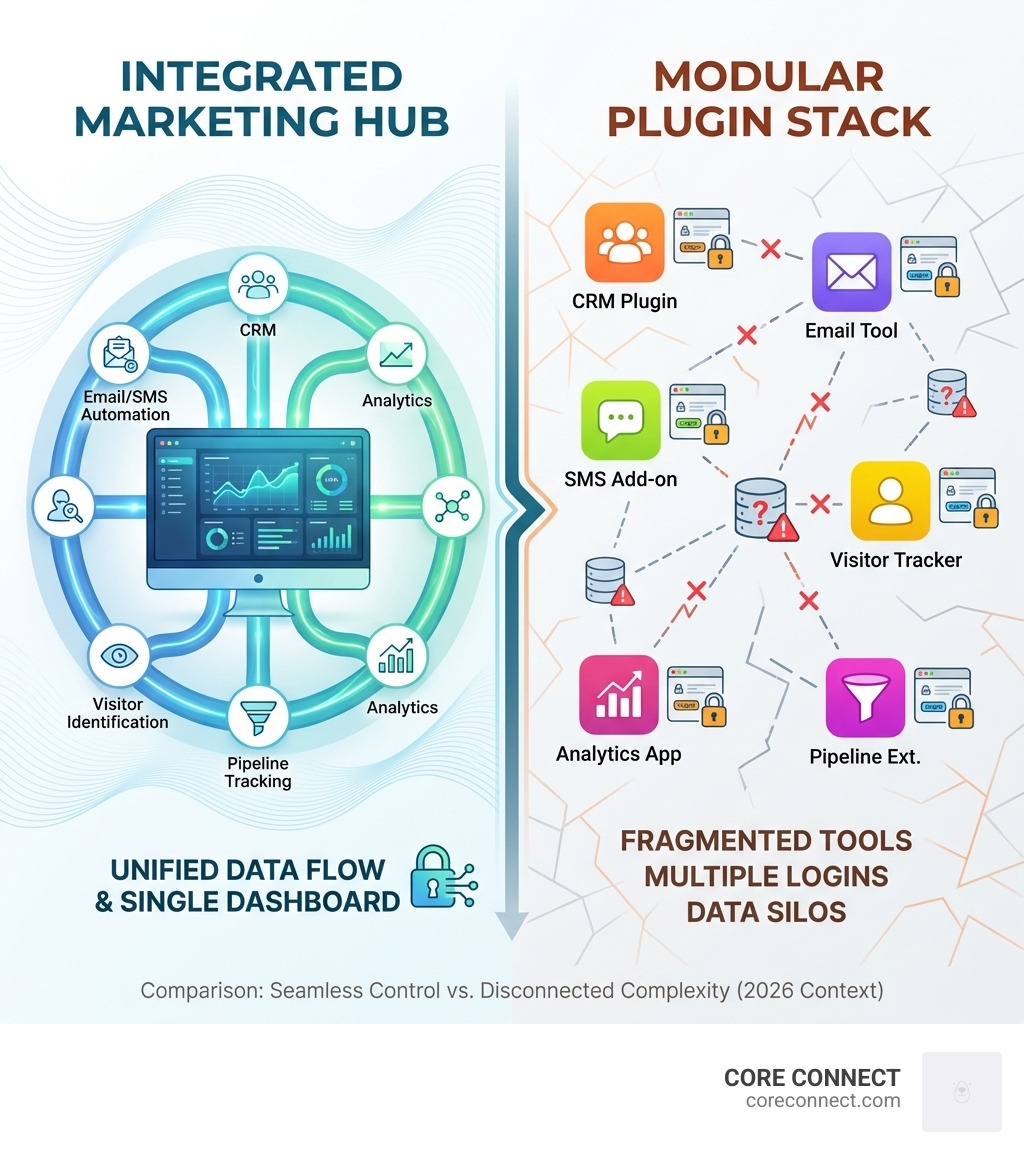
- Reveal Marketing Hub is an all-in-one platform that combines CRM, email/SMS automation, visitor identification, pipeline tracking, and analytics in a single system you own and control
- Plugins are individual tools (often third-party) that require separate subscriptions, manual integration, ongoing updates, and technical management
- Key difference: Reveal eliminates data silos, reduces security risks, and provides real-time visitor intelligence without needing multiple logins or complex workflows
- Best for Hub: Businesses tired of tool overload, those scaling multi-channel campaigns, or teams wanting marketing automation without heavy IT dependency
- Best for Plugins: Highly technical teams with custom needs, or very early-stage businesses testing different channels before committing to a unified system
If you’re already spending on ads and SEO but struggling with inconsistent results, fragmented data, or a website that feels like it’s working against you rather than for you—this comparison matters.
The research is clear: for every $1 spent on marketing automation, retail brands see an average return of $5.44. But that ROI only materializes when your systems actually talk to each other. When your CRM doesn’t sync with your email tool, your analytics don’t track the right conversions, and your team is managing five different logins just to understand what’s working—you’re not automating. You’re just busy.
Reveal Marketing Hub was built to solve that exact problem. It’s a unified platform designed for businesses that want to own their marketing infrastructure, not rent it piecemeal. Instead of stitching together various third-party plugins, platform add-ons, external analytics, and standalone CRMs, Reveal centralizes everything: visitor identification, lead nurturing, pipeline tracking, email and SMS automation, and real-time reporting.
Plugins, on the other hand, offer flexibility and specialization. Standalone marketing platforms or various website extensions can be powerful—but they also introduce complexity. Each plugin is a dependency. Each integration is a potential failure point. And every update, subscription renewal, or compatibility issue adds friction to your growth.
In 2026, the shift is clear. Businesses using AI-driven automation and integrated analytics are seeing drastic improvements in campaign efficiency and personalization. Meanwhile, companies stuck managing fragmented plugin stacks are spending more time troubleshooting than optimizing.
I’m Stephen Sovenyhazy, founder of CORE CONNECT, and over the past 20+ years I’ve helped businesses transition from expensive, fragmented systems to platforms they actually own—including implementing and optimizing solutions like Reveal Marketing Hub vs Plugins for long-term scalability. This guide will show you exactly when a unified hub makes sense, when plugins are still the right call, and how to avoid the hidden costs that quietly drain ROI.
Understanding Reveal Marketing Hub vs Plugins
To understand the debate of Reveal Marketing Hub vs Plugins, we first have to look at how most businesses in the Lowcountry grow. Typically, a business starts with a website. Then they add a contact form plugin. Then they realize they need email marketing, so they sign up for a third-party service and install another plugin to connect it. Next comes a CRM, a tracking pixel for ads, and maybe an SMS tool.
Before you know it, your “simple” website is held together by digital duct tape.
Reveal Marketing Hub is our proprietary growth platform that replaces this “patchwork” approach. It unifies your CRM, email and SMS follow-up, pipeline tracking, and automation into one interface. The standout feature is our advanced website visitor identification technology. While standard plugins might tell you that “someone” visited your site, Reveal exposes who is visiting, how they found you, and what specific actions they took.
The Core Differences in Reveal Marketing Hub vs Plugins
The most immediate difference is how data flows. In a plugin-based environment, data is often “trapped.” Your website form plugin might send an email notification, but does that data automatically move into your CRM with a full history of the pages that user visited? Usually, no—unless you spend hours configuring complex integrations.
With Reveal Marketing Hub, the CRM integration is native. There is no “syncing” because the data lives in the same house. This eliminates “technical debt”—the long-term cost of maintaining a complex, fragile system. When a plugin updates and breaks your connection to your CRM or your email tool, your marketing stops. In a unified hub, there are no third-party conflicts to worry about.
Furthermore, the average return of $5.44 for every dollar spent on automation is much easier to achieve when you aren’t paying for ten different subscriptions. We see many Charleston businesses suffering from “subscription fatigue,” paying for features they don’t use across multiple plugins when one hub could do it all more effectively.
Why Integration Trumps Modular Stacks in 2026
As we look toward 2026, the marketing landscape is shifting toward privacy and first-party data. With the decline of third-party cookies, owning your own data is no longer optional—it’s a survival requirement.
Plugins often rely on external scripts that can slow down your site and raise privacy concerns. A unified hub allows for better privacy compliance because you have total control over how data is collected and stored. According to AI trends reshaping marketing in 2026, staying agile is key. Integrated systems allow AI-driven features—like predictive lead scoring and automated follow-ups—to work across your entire dataset rather than just one “silo” like your email list.
The Strategic Advantages of a Unified Marketing Hub
The biggest win for our clients in Mount Pleasant and Charleston is revenue visibility. When you use a fragmented plugin stack, it’s nearly impossible to answer the question: “Which specific blog post led to this $10,000 sale?”
Reveal Marketing Hub connects the dots. Because the visitor identification technology tracks the user from their first anonymous visit through to the final sale in the CRM, you get a clear picture of your ROI. This is what we call “System Clarity.”
Scaling with Reveal Marketing Hub vs Plugins
Scalability is where the Reveal Marketing Hub vs Plugins debate usually ends. If you want to run a multi-channel campaign—say, an email sequence followed by an SMS reminder and a task for your sales team—doing that with plugins requires an integration tool or an “iPaaS” middleman. This adds another layer of cost and a potential point of failure.
In Reveal, this is a single workflow. You can automate:
- Email Automation: Drip campaigns based on specific website behavior.
- SMS Follow-up: Instant texts to leads who visit high-value pages (like your pricing page).
- Pipeline Tracking: Automatically moving a lead from “New” to “Qualified” based on their engagement.
This level of lifecycle marketing ensures no lead falls through the cracks, which is vital in competitive local markets like the Lowcountry.
Real-Time Visitor Intelligence and ROI
Most businesses are flying blind. They see “1,000 visitors” in standard analytics tools, but they don’t know who those people are. Reveal changes the game by turning anonymous traffic into actionable sales insight.
Imagine knowing that a local developer just spent 10 minutes looking at your services page. With a plugin, you’d never know. With Reveal, that information is pushed to your dashboard in real-time. AI’s impact on marketing technology in 2025 emphasizes that integrated analytics drastically improve personalization. When you know exactly what a visitor is interested in, your follow-up is relevant, not annoying.
| Feature | Reveal Marketing Hub | Plugin-Based Stack |
|---|---|---|
| Data Source | Unified (Single Source of Truth) | Fragmented (Data Silos) |
| Setup Time | Fast (Pre-integrated) | Slow (Manual Connections) |
| Visitor ID | Real-time & Native | Often requires extra tools |
| Maintenance | Included / Managed | User’s responsibility |
| Security | High (Centralized) | Variable (Third-party risks) |
Hidden Costs and Security Risks of the Plugin Approach
Many business owners choose plugins because the “entry price” is low. A $49/year plugin sounds better than a comprehensive platform. But let’s look at the “hidden” costs:
- Subscription Fatigue: Five $30/month plugins cost more than a single hub.
- Developer Dependency: When a platform update breaks your “patchwork” system, you have to hire a developer to fix it.
- Site Speed: Every plugin adds code to your site. Too many plugins lead to “bloat,” which kills your SEO and frustrates visitors.
- Security Vulnerabilities: Each third-party plugin is a potential “backdoor” for hackers. In fact, most website security breaches come from outdated or poorly coded plugins.
With Reveal Marketing Hub, we manage the infrastructure. You don’t have to worry about “Plugin A” fighting with “Plugin B.” This stability allows your team to focus on creative strategy rather than manual tasks.
Choosing the Right System for Your Business Growth
So, when it comes to Reveal Marketing Hub vs Plugins, which should you choose?
Choose Reveal Marketing Hub if:
- You are a growing business in South Carolina that needs clear ROI data.
- You want to automate your sales pipeline without becoming a part-time IT manager.
- You want to see who is on your website in real-time to close deals faster.
- You value a “Done-For-You” or “Professional-Grade” system over a DIY project.
Stick with Plugins if:
- You are in the very early “hobbyist” stage and have more time than budget.
- You have a full-time in-house developer who loves managing complex integrations.
- You only need one very specific function (like a simple contact form) and nothing else.
At CORE CONNECT, we find that marketing-led teams—those focused on demand generation and revenue—thrive with Reveal. It gives them the “Systems behind the Sales” that they need to scale with control.
Frequently Asked Questions about Marketing Hubs
Is a marketing hub more expensive than using free plugins?
Initially, “free” plugins look cheaper. However, when you account for the cost of your time, the “Pro” versions needed for actual automation, and the lost revenue from leads that fall through the cracks of a fragmented system, a unified hub is almost always more cost-effective. Remember: for every $1 in automation, the return is $5.44. You rarely get that return from a “free” tool that doesn’t sync your data.
How does visitor identification work in a unified platform?
Reveal uses advanced technology to match IP addresses and browser fingerprints against a massive database of business and consumer records. Unlike a simple plugin that just counts “hits,” Reveal identifies the company name, location, and intent of the visitor. This data is fed directly into your CRM, allowing for immediate, personalized follow-up.
Can I migrate from a plugin-based site to a marketing hub?
Absolutely. We specialize in helping businesses transition from “fragmented” to “unified.” We handle the heavy lifting—migrating your contacts, setting up your automated sequences, and ensuring your visitor tracking is live—so you can start seeing results without the technical headache.
Conclusion
The choice between Reveal Marketing Hub vs Plugins isn’t just about software; it’s about how you want to run your business. Do you want to spend your weekends troubleshooting plugin updates and trying to figure out why your leads aren’t syncing? Or do you want to wake up to a dashboard that tells you exactly who was on your site and which automated campaigns are driving revenue?
At CORE CONNECT, we believe in system clarity. Whether you use our fully managed services or run Reveal in-house, our goal is to give you the visibility and control you need to grow sustainably in Charleston and beyond.
Don’t let your marketing data stay hidden in silos. It’s time to expose the opportunities already visiting your website.