
Why Marketing Analytics and Automation Matter More Than Ever
Marketing analytics and automation is the practice of collecting, analyzing, and acting on marketing data through automated systems to improve campaign performance, prove ROI, and create personalized customer experiences at scale.
Quick Answer: What You Need to Know
- What it is: A system that combines data collection, analysis, and automation tools to measure marketing performance and execute personalized campaigns across multiple channels
- Why it matters: 80% of marketers say their ability to track ROI needs improvement, and 90% report that privacy changes have altered how they measure performance
- Core components: Data collection tools, analytics platforms, automation software, and AI-driven insights
- Key benefits: Improved ROI, better customer understanding, optimized budget allocation, and the ability to personalize at scale
- Common tools: CRM systems, marketing automation platforms, analytics dashboards, and customer data platforms (CDPs)
The digital marketing landscape has become overwhelming. From web to mobile, email to social channels, and streaming ads to voice search—businesses are drowning in data but starving for insights.
You’re already investing in digital ads and SEO. Traffic is coming in. But conversions feel inconsistent. Brand messaging seems fragmented. And it’s nearly impossible to tell whether your website is helping or quietly hurting performance.
Here’s the hard truth: 71% of marketers still evaluate cross-channel performance in silos, even though 98% understand the importance of a unified view. The result? Decisions based on incomplete data. Budget wasted on underperforming channels. And opportunities missed because insights arrive too late to act.
The gap between data and dollars isn’t about collecting more information. It’s about connecting the dots between customer behavior, campaign performance, and actual revenue—then automating the actions that drive growth.
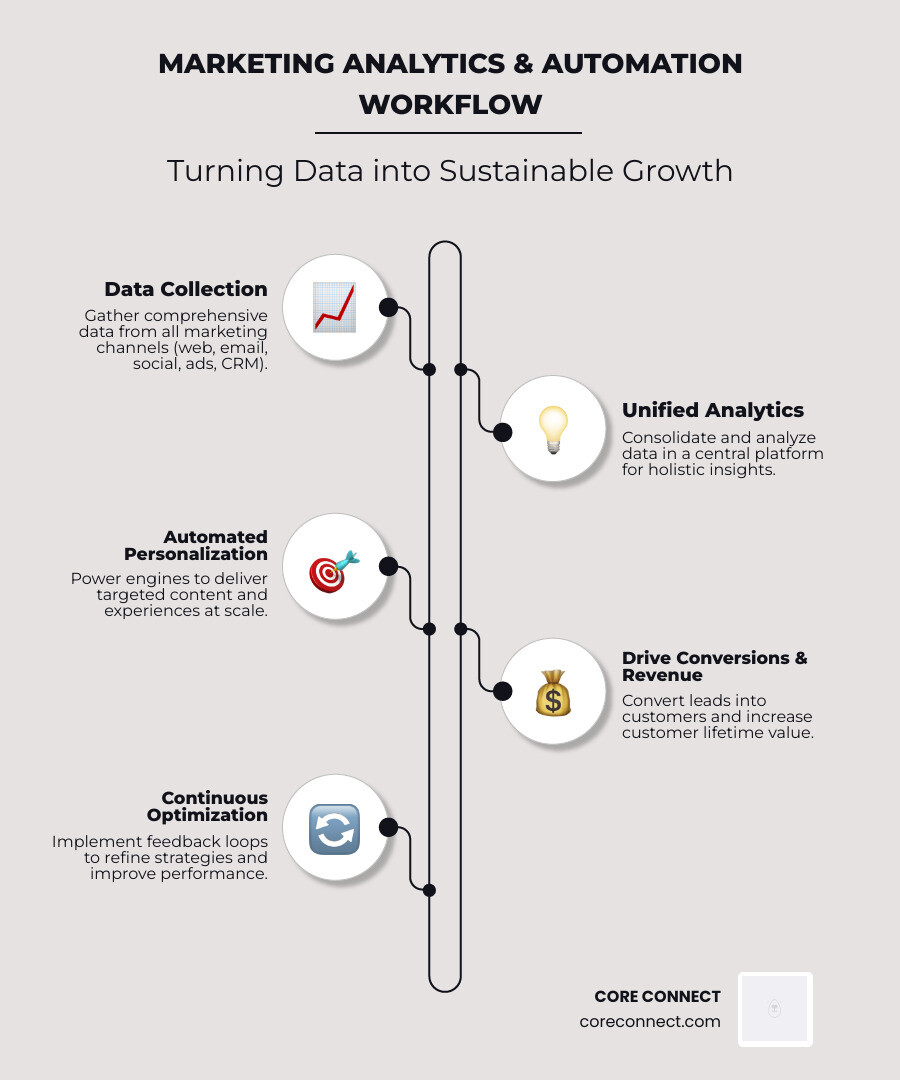
This is where marketing analytics and automation becomes your competitive advantage. Not as a reporting tool, but as a growth engine that turns scattered data into strategic decisions and manual processes into scalable systems.
When done right, marketing analytics and automation doesn’t just prove what happened. It predicts what’s next and automatically optimizes your marketing to get there faster.
I’m Stephen Sovenyhazy, founder of CORE CONNECT, and over the past 20 years I’ve helped businesses replace ad dependency with sustainable growth by building analytics systems that measure what actually matters. My work in marketing analytics and automation has helped clients increase organic traffic by 100–300% and convert anonymous visitors into measurable revenue opportunities through data-driven strategies and platform automation.
The Strategic Importance of Marketing Analytics and Automation
In the modern business environment—especially for companies operating in competitive hubs like Charleston and Mount Pleasant—scaling a business requires more than just “trying harder.” It requires a shift from gut-feeling marketing to a system of high-level marketing intelligence.
Efficiency and scalability are the two biggest problems for growing businesses. You cannot manually email every lead, nor can you manually analyze every click. Marketing analytics and automation provides the infrastructure to handle these repetitive tasks while simultaneously measuring their impact. According to research, only 33% of marketers strongly agree they gain insights fast enough for impactful decision-making. That delay is where revenue is lost.
By integrating these systems, we move from reactive marketing (looking at what happened last month) to proactive marketing (predicting what will happen next). This creates a fertile ground for healthy, long-term relationships with your customers. Instead of blasting a generic message to everyone, you are nurturing individuals through the customer lifecycle, from initial awareness to becoming vocal brand advocates.
At CORE CONNECT, we believe that the system behind the campaign is just as important as the campaign itself. Our marketing services are built on this foundation of clarity and control, ensuring that every dollar spent in the Lowcountry is a dollar that can be tracked back to a business outcome.

Creating Personalized Customer Journeys with Marketing Analytics and Automation
A customer journey is the sum of every individual, personalized experience a person has with your brand. Today’s consumers expect relevance. In fact, customers who see content custom to their interests are five times more likely to engage with a brand.
Marketing analytics and automation allows us to create these journeys at scale using:
- Dynamic Content: Email subject lines and website sections that change based on who is looking at them.
- Behavioral Triggers: If a prospect in Charleston visits your pricing page three times but doesn’t book a call, our Reveal Marketing Hub can automatically trigger a personalized SMS or email follow-up.
- Multi-channel Coordination: Ensuring that your Facebook ads, Google search results, and email newsletters all tell a consistent story to the same user.
- Touchpoint Optimization: Identifying exactly where people “drop off” in your funnel and fixing the leak automatically.
Through CORE CONNECT’s Reveal Marketing Hub, we unify these touchpoints. We don’t just see “traffic”; we see individuals navigating a path you’ve designed for them.
Streamlining Cross-Team Processes
One of the greatest benefits of a unified system is the bridge it builds between marketing and sales. Too often, marketing generates “leads” that sales finds useless, or sales ignores leads because they lack context.
Automation eliminates these silos through:
- Unified Customer Timeline: Sales can see every whitepaper downloaded, every email opened, and every page visited before they even pick up the phone.
- Automated Lead Handoffs: Hot leads are routed instantly to the right representative in your Mount Pleasant office with full context.
- Bi-directional Sync: When a salesperson moves a deal to “Closed-Won” in the CRM, the marketing system automatically stops the “New Lead” ads and starts the “Onboarding” email sequence.
- Closed-loop Reporting: Marketing can finally see which specific ad campaigns resulted in actual dollars, not just clicks.
Core Components and Tools for Data-Driven Marketing
To turn data into dollars, you need a stack that covers the three pillars of analytics: understanding the past, predicting the future, and prescribing the action.
| Analytics Type | What it Answers | Example in Action |
|---|---|---|
| Descriptive | What happened? | “Our Charleston SEO campaign drove 500 visitors last month.” |
| Predictive | What might happen? | “Based on current trends, we expect 15% more leads in the Lowcountry next quarter.” |
| Prescriptive | What should we do? | “To hit our revenue goal, we should increase spend on the ‘Home Services’ ad group by 20%.” |
A robust stack starts with search engine optimization to drive high-intent traffic, followed by a data collection layer that captures every interaction. This data then flows into your CRM and automation platform—like CORE CONNECT’s Reveal—where it is transformed into usable insights.
Essential Tools for Implementing Marketing Analytics and Automation
You don’t need a thousand tools; you need the right tools that talk to each other.
- Data Warehouses: For larger organizations, platforms like Google BigQuery or Snowflake act as a central “brain” for all your data.
- Visualization Tools: Looker Studio, Tableau, and Power BI turn spreadsheets into visual stories that help you make decisions in seconds.
- CORE CONNECT Reveal Marketing Hub: Our proprietary platform unifies your CRM, email, SMS, and pipeline tracking. It solves the “71% silo” problem by giving you one single source of truth.
- First-Party Data Collection: With the retirement of third-party cookies, your ability to collect data directly from your visitors (through forms, surveys, and site behavior) is your most valuable asset.
Key Steps in Implementation
Implementation isn’t a “set it and forget it” project. It’s a cycle:
- Objective Setting: Define exactly what success looks like. Is it a lower Cost Per Acquisition (CPA) or a higher Customer Lifetime Value (CLV)?
- Data Tracking: Set up your “pixels” (Google Ads, Meta, LinkedIn) and Tag Manager correctly. If your tracking is broken, your automation will be too.
- Interpretation: Look for patterns. If email open rates are high but conversions are low, your call-to-action needs work.
- Optimization & Iteration: Use A/B testing to refine your messages. Small 1% improvements across each stage of the funnel lead to massive revenue growth over time.
Leveraging AI for Hyper-Personalization and Optimization
Artificial Intelligence has moved from a sci-fi concept to a daily marketing necessity. In the field of marketing analytics and automation, AI acts as a force multiplier. It processes information at a speed humans simply can’t match.
One of the most impactful AI use cases is Predictive Lead Scoring. Instead of treating every lead the same, AI analyzes historical data to identify which prospects are most likely to convert. It looks at engagement signals, firmographics, and even sentiment. This allows your sales team to stop chasing “window shoppers” and focus on high-value opportunities.
Furthermore, with 50% of U.S. consumers using voice assistants daily, AI is critical for optimizing content for natural speech patterns and semantic search. If a customer asks Siri for the “best marketing agency in Charleston,” your data needs to be structured so AI can find and recommend you.
Changing Visibility and Attribution with AI
Attribution—the art of figuring out which marketing effort gets the credit for a sale—is getting harder. Between the “dark social” (recommendations in private Slack groups or texts) and the deprecation of cookies, the “measurement gap” is widening.
AI helps close this gap through:
- Marketing Mix Modeling (MMM): Using aggregate data to estimate impact when individual tracking fails.
- Incrementality Testing: Running “lift tests” to see what would have happened if you hadn’t run that ad campaign. This proves the true value of your spend.
- Conversion APIs: Tools like Meta’s Conversions API allow your server to talk directly to the ad platform, bypassing browser-based tracking issues.
Future Trends in AI Analytics
The future of marketing analytics and automation is “agentic.” We are moving toward Autonomous Marketing Operations, where AI agents don’t just report on data—they act on it.
- Generative AI for Creative: Automatically testing thousands of ad variations to see which image or headline resonates best with a Mount Pleasant audience.
- Predictive Forecasting: AI that alerts you before your pipeline dries up, suggesting a budget shift to top-of-funnel awareness campaigns.
- Hyper-Personalization: Content that adapts in real-time, not just to a user’s name, but to their current mood or intent based on their navigation speed and scroll depth.
Overcoming Implementation Challenges and Measuring Success
Implementation isn’t without its problems. Privacy regulations like GDPR and the “iOS 14 effect” have made tracking more difficult. 90% of marketers have had to change their measurement strategies recently.
The biggest challenge, however, is Siloed Data. When your email data lives in one tool, your ad data in another, and your sales data in a third, you are flying blind. This is why we focus heavily on website visitor identification. By revealing the “anonymous” traffic on your site, we turn a mystery into a lead, giving you the first-party data you need to stay compliant and effective.
Measuring Success with KPIs
To know if your marketing analytics and automation efforts are working, you must move beyond vanity metrics (like “likes” or “impressions”) and focus on revenue-driving Key Performance Indicators:
- Conversion Rates: The percentage of visitors who take a desired action.
- Customer Lifetime Value (CLV): How much a customer is worth over the entire duration of your relationship.
- Email ROI: Email continues to rise, with a 15% increase in outbound volume last year. Measuring revenue per email is vital.
- Engagement Scoring: Assigning points to leads based on their actions (e.g., +10 for a webinar, +50 for a pricing page visit).
Developing a Strategic Approach
Don’t try to boil the ocean on day one.
- Define Business Objectives: Start with one clear goal (e.g., “Reduce lead response time to under 5 minutes”).
- Unify Your Data: Get your sources into one place.
- Implement a Pilot Program: Test automation on a small segment of your audience before rolling it out globally.
- Foster a Data-Driven Culture: Ensure your team knows how to read the dashboards and, more importantly, how to act on them.
Frequently Asked Questions about Marketing Analytics and Automation
How do I measure the ROI of my automation efforts?
ROI is measured by comparing the cost of the software and management against the increase in revenue and the time saved. For example, if automation saves your team 20 hours a week and increases lead conversion by 10%, the ROI is often measured in the hundreds of percent. 86% of executives using predictive analytics reported increased ROI within two years.
What is the role of first-party data in modern analytics?
First-party data is the information you collect directly from your audience. In a world without third-party cookies, this is your gold mine. It allows for accurate attribution and hyper-personalization because it is based on actual interactions with your brand, not inferred data from elsewhere.
How does AI improve marketing visibility and attribution?
AI can “fill in the blanks.” When a user switches devices or clears their cookies, AI uses pattern recognition to link those sessions together. It also allows for “Conversational Analytics,” where you can ask a system, “Which campaigns in Charleston drove the most revenue last month?” and get an instant, data-backed answer.
Conclusion: Building a Sustainable Growth Engine
The shift from “Data to Dollars” isn’t a luxury—it’s a requirement for any business that wants to survive and thrive in the Lowcountry’s evolving economy. Marketing analytics and automation provides the clarity you need to stop guessing and start growing.
By combining conversion-focused websites with the power of Reveal Marketing Hub, we help you see the “invisible” parts of your sales funnel. You gain the ability to identify anonymous visitors, automate the follow-up that converts them, and measure every step of the process with surgical precision.
Whether you are looking for fully managed services or the professional-grade tools to run your marketing in-house, our growth platform services are designed to give you back control.
Don’t let your data sit in silos while your competitors use theirs to win your customers. It’s time to turn your marketing into a predictable, scalable revenue machine. Let’s build your growth engine together.