
Why 98% of Your Website Traffic Is Invisible—And What to Do About It
B2B website visitor identification software helps you see which companies are visiting your site, what pages they view, and when they’re showing buying intent—without waiting for them to fill out a form.
Most B2B websites convert less than 2% of visitors. The remaining 98% leave without making contact. That’s not a marketing problem—it’s a visibility problem.
When someone from your ideal customer profile lands on your pricing page, reads three case studies, and checks your integrations page, that’s a buying signal. But if they don’t fill out a form, you’ll never know they were there.
This is where visitor identification software changes the game. Instead of waiting for prospects to raise their hand, you can see which companies are already showing interest, what content resonates with them, and when to reach out with a personalized message that fits their actual behavior.
I’m Stephen Sovenyhazy, founder of CORE CONNECT in Charleston, South Carolina. Over the past 20+ years building digital platforms, I’ve helped businesses convert anonymous traffic into measurable sales opportunities using b2b website visitor identification software integrated with CRM automation and SEO strategy. This guide breaks down how these tools work, which ones deliver real results, and how to choose the right solution for your business.
What is B2B Website Visitor Identification Software?
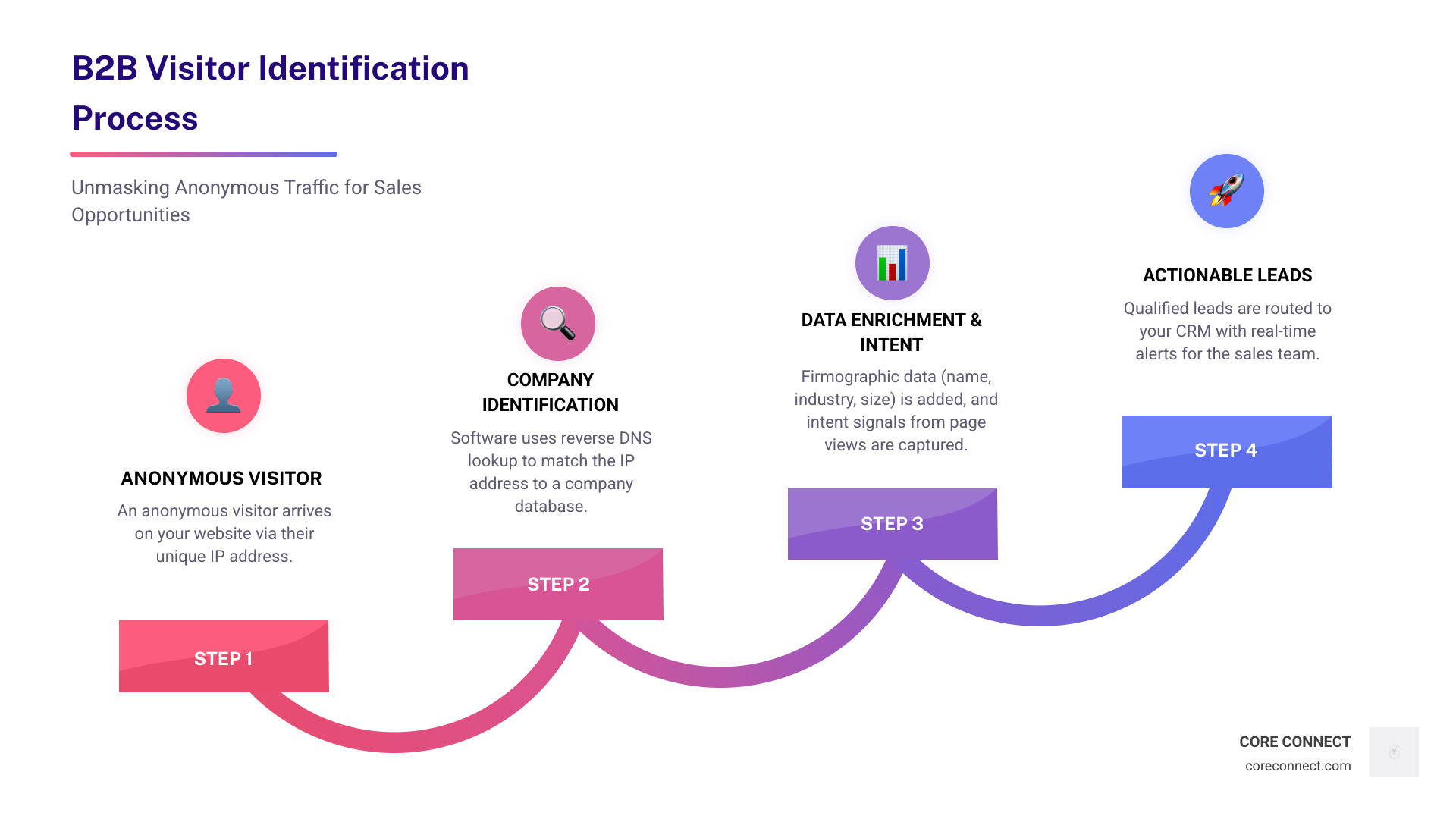
At its core, b2b website visitor identification software is a technology that unmasks the anonymous traffic hitting your site. In B2B, 98% of B2B website visitors remain anonymous, representing a massive leak in your sales funnel. Without this software, you’re essentially running a store where 98 out of 100 people walk in, browse the high-ticket items, and leave without ever saying a word.
This process, often called website deanonymization, uses a combination of digital signals to identify the entities behind the screen. Instead of seeing a random string of numbers (an IP address), we see that a decision-maker from a specific company in the Lowcountry or a major enterprise is currently reading your “How it Works” page. This provides more info about website visitor identification that goes beyond simple vanity metrics like “page views.”
By capturing firmographic data—such as company size, industry, and revenue—and pairing it with intent signals (like how many times they’ve visited your pricing page), we gain deep pipeline visibility. We aren’t just guessing who might be interested; we are seeing the interest as it happens in real-time.
Key Features of B2B Website Visitor Identification Software
When we look for the right tool to integrate into our Reveal Marketing Hub, we prioritize features that make data actionable. Here is what you should look for:
- IP Lookup & Reverse DNS: The foundational tech that matches an IP address to a specific business entity.
- Real-Time Alerts: Because B2B sales move fast, getting an alert in Slack or email the moment a target account lands on your site is crucial.
- CRM Integration: The data is only useful if it lives where your sales team works. Seamlessly pushing identified leads into platforms like HubSpot ensures no one falls through the cracks.
- Lead Scoring: Automatically ranking visitors based on their actions (e.g., visiting a demo page scores higher than reading a blog post).
- Firmographic Filters: The ability to sort visitors by geography (like Charleston or Mount Pleasant), employee count, or turnover.
- Technographics: Seeing what other software your visitors use, which helps us understand if they are a good fit for our specific solution.
Identifying High-Intent Leads and Lost Opportunities
One of the most powerful ways we use this technology is to revive “lost” opportunities. Imagine a prospect who went cold six months ago. Suddenly, our software alerts us that three people from that same company are back on our site, looking at our latest case studies. That is a massive buying signal.
In fact, 83% of B2B decision-makers prefer digital interactions over face-to-face meetings. They want to do their own research, poke around your pricing, and read your documentation before ever talking to a sales rep. By tracking these digital footprints, we can prioritize accounts that are “in-market” right now. This allows for proactive sales triggers—reaching out not with a cold pitch, but with a helpful resource that matches their current research phase.
How the Technology Unmasks Anonymous Traffic
You might be wondering: “How do they actually know it’s a specific company?” It feels a bit like magic, but it’s actually a sophisticated data play.
The software primarily uses Reverse DNS (rDNS). Every business has a fixed range of IP addresses. When a device on that network accesses your site, the software looks up that IP against a massive database of over 50 billion+ addresses. It then “enriches” that data with information from verified data partners.
More advanced tools now use Identity Graphs. These graphs link professional profiles, work emails, and devices together. This is how advanced identification systems can sometimes identify the specific person browsing, especially for US-based traffic, by matching their digital footprint against professional networks.
| Feature | IP-Lookup Tracking | Cookie-Based Tracking |
|---|---|---|
| Identification Level | Company-level (mostly) | Individual-level (if known) |
| Privacy Risk | Low (Legitimate Interest) | Higher (Requires Consent) |
| Persistence | Works across sessions | Often blocked by browsers |
| B2B Accuracy | High for office networks | Low if cookies are cleared |
By using these proprietary databases, we can turn a “visit from Charleston, SC” into “A Marketing Manager from a $50M manufacturing firm in the Lowcountry just spent 12 minutes on your service page.”
Strategic Benefits for Sales and Marketing Teams
When we implement b2b website visitor identification software, we aren’t just adding a tool; we are changing the entire GTM (Go-To-Market) strategy. It bridges the gap between marketing “traffic” and sales “revenue.”
For marketing, it provides more info about marketing services by showing which campaigns actually attract the right people. If we run a LinkedIn ad and it brings in 500 clicks, but 0 forms are filled, most marketers would call that a failure. But if our visitor ID software shows that 40 of those clicks came from companies on our Target Account List, that campaign is actually a goldmine.
For sales, it enables Account-Based Marketing (ABM) at scale. Instead of SDRs making 100 cold calls a day to a purchased list (which usually results in a disappointing <2% response rate), they can focus their energy on the 5 companies that were on the website this morning. This personalization accelerates the sales cycle because the conversation starts while the problem is top-of-mind for the prospect.
Maximizing ROI with B2B Website Visitor Identification Software
Let’s talk numbers. Optimistic benchmarks place conversion rates at 10% for paid traffic. That means 90% of your ad spend is essentially “wasted” if you can’t identify who those people were.
By identifying the companies in that remaining 90%, we can:
- Optimize Ad Spend: Stop spending money on keywords that attract the wrong industries.
- Hyper-Targeted Retargeting: Instead of retargeting everyone, we only show ads to ICP (Ideal Customer Profile) companies that have already visited us.
- Revenue Attribution: We can finally see the “Dark Social” path—how a visitor found us through a private Slack group or a LinkedIn mention before landing on the site.
This is a core part of our SEO services, as it allows us to see which organic keywords are driving actual business interest, not just high-volume “fluff” traffic.
Privacy, Compliance, and the Future of Tracking
In the era of GDPR and CCPA, privacy is the first question we get asked. It’s a valid concern. However, B2B visitor identification is generally considered compliant under Legitimate Interest (Article 6(1)(f) of the GDPR) when you are only collecting company-level data.
Leading platforms in this space offer completely cookieless tracking options. They identify companies based on IP addresses without placing any tracking cookies on the visitor’s device. This eliminates the need for intrusive cookie banners for the purpose of identification and keeps you 100% compliant.
As we look toward the future, the “Identity Graph” will become even more important. With Google Chrome set to phase out third-party cookies, the industry is moving toward first-party data and server-side identification. Choosing a tool with ISO 27001 certification and EU-only hosting (for those with international reach) ensures your data residency requirements are met while still giving you the insights you need to grow.
Frequently Asked Questions about Visitor Tracking
Is B2B website visitor identification legal under GDPR?
Yes, as long as it is implemented correctly. Most platforms identify the company rather than the individual, which falls under the “legitimate interest” clause of GDPR. For person-level identification, it is currently focused on US-based traffic where CCPA and CPRA regulations apply, which have different requirements than Europe’s GDPR.
How accurate is company-level identification?
Identification rates typically vary between 20% and 40%, depending on the tool and the region. In the US, some providers can hit higher match rates by using a “waterfall” of 20+ data providers to verify the information.
Can this software identify specific individuals?
Some can! While legacy tools only show the company name, newer “person-level” tools use identity graphs to show you the specific LinkedIn profile of the person browsing (primarily for US traffic). Other advanced systems can take a company signal and use AI to find the most likely decision-makers at that firm for you to contact.
Conclusion
The days of flying blind with your website traffic are over. By implementing b2b website visitor identification software, you turn your website from a passive brochure into an active member of your sales team.
At CORE CONNECT, we believe that real-time intelligence is the key to sustainable scaling. Whether you are in Charleston, Mount Pleasant, or anywhere in the Lowcountry, having clear visibility into who is visiting your site allows you to make smarter decisions and act faster on opportunities. Our Reveal Marketing Hub was built specifically to unify this visitor data with your CRM and automation, providing a growth platform that gives you total control over your pipeline.
Don’t let 98% of your opportunities walk out the door. It’s time to see beyond the click and start building a predictable revenue engine. If you’re ready to unmask your traffic and turn anonymous visits into real conversations, we’re here to help you build the system that makes it happen.